Category: Motorcycling

Motorcycling is a passion I found later in life and I’ve embraced it with gusto. It’s provided me with such joy, fulfillment, and confidence. And also a whole lot of suffering.

  • A Motorcycling Ambassador

    A Motorcycling Ambassador

    As a rider, I believe in continually training. Improving my skills not only increases my confidence and enjoyment of motorcycling, it helps me stay as safe as possible. Our roadways are an unforgiving environment dominated by automobiles. On a daily basis, I share the road with people who do not prioritize safety and responsibility when driving. So I wear full gear and I train.

    My latest round of continuing education was participating in the Motorcycle Safety Foundation’s (MSF) Advanced Rider Course (ARC). I’ve taken a lot of MSF classes, most of them focused on low-speed maneuvering. The ARC is a bit different from my previous courses. It focuses more on body position and crash-avoidance skills and includes classroom work that addresses our personal assessment of attitude, perception, and behavior.

    msf advanced rider course - val in real life
    Building riding skills involves more than just saddle time. Risk assessment and decision making are just as important.

    The reluctant ambassador

    One of the discussions during our classroom time was being an ambassador for our motorcycling community—riding responsibly to give riders a good name instead of reasons for drivers to resent us. Even though I strive to be an ambassador when I’m in the saddle, I still have a lot of conflicting feelings about the effort I put into it.

    Problem #1

    Squids. The jerk riders you see careening recklessly through traffic with little or no protective gear. Trust me, squids make me as angry as poor drivers do. Possibly even more so because I know they’re contributing to my vulnerability on the road by creating animosity between riders and drivers.

    Problem #2

    Driver behavior. Distracted driving is a well-documented, growing epidemic. I get a more than a bit, shall we say, “put out” about constantly working on improving my skills when drivers don’t. Most haven’t developed reasonable perception and risk assessment skills so we riders are left to make up for their inadequacies.

    Problem #3

    Human nature. Even though squids are the exception not the rule among the riding population, we humans are prone to focus on the negative. The “negativity bias” kicks in even when a negative experience represents only a small fraction of our total experience.

    That means I can be the most responsible rider in the world yet that isn’t what sticks in drivers’ memories. The few riders acting like jerks is what many drivers will remember. That means I’m not being judged by my personal behavior but instead carry the weight of an unfair perception of motorcyclists.

    There’s not a lot I can do to combat that. My hi-viz gear, well-lit motorcycles, continual training, and responsible riding don’t seem to have much impact on that perception.

    Problem #4

    Stigma. Non-riders often have a knee-jerk reaction to motorcycling as irresponsible, dangerous, and the domain of hooligans. Again, stereotyping comes into play although by some standards that’s slowly fading.

    When someone says the word “biker”, what comes to mind first? Probably not your neighbor—the doctor, the lawyer, the school teacher, the retired couple down the street. Yet those people are as likely to be riding as any other person. I’m guessing me as the middle-aged, female, blonde mom in full protective gear wasn’t your first thought, right?

    val at msf campus - val in real life
    I work hard to build my riding skills. The story doesn’t end there, though. I need you to work hard to be a better driver, too.

    Problem #5

    Decision-making. Drivers who don’t also ride have no understanding of the different decisions we have to make in piloting our bikes. That means our actions are frequently misinterpreted. You may chalk me up to being a squid or greedy when in fact I’ve had to maneuver to avoid a hazard that you are completely unaware of as a driver of a car.

    Problem #6

    Machine differences. Drivers often don’t understand our machines are not simply two-wheeled cars. Our performance capabilities and vulnerabilities are vastly different so we must operate differently. Not disregarding traffic laws, mind you, but our decisions about lane position, speed, and hazard avoidance are not going to be the same as a driver’s. As a result, our actions are often interpreted negatively.

    Just as a tractor-trailer driver faces different challenges from the rest of us, we have to accept that all of these machines are not created equally. Yet we need to share the same road space. That requires cooperation and understanding we often don’t get from non-riding drivers.

    msf advanced rider course - val in real life
    Riders spending their time and money to improve skills at an advanced MSF class.

    One conversation at a time

    Having said all that, I still choose to be a motorcycling ambassador, as frustrating as it can be. When I have the opportunity to speak to a non-rider, I hope I’m doing a good job of dispelling these misconceptions. Even one person at a time, I think it’s a valuable investment.

    So take the time to chat with a rider. Ask them why they ride, ask them about their bike or gear, ask them about their last trip—anything to start a conversation that builds understanding.

    motorcycling in tijuana - val in real life
    This is an incredibly dangerous situation for a rider so I will make changes to my position which you might not understand.

    Friendly advice

    I have some tips for you non-riding drivers I haven’t had a chance to talk with yet

    • Understand what’s involved in motorcycling before you judge our actions.
    • LOOK FOR US! If you do nothing else, train yourself to see smaller vehicles. Just because we’re not as easy to see doesn’t mean you don’t have the responsibility to do so. When you don’t, we lose. Always. If you’ve followed me here for any length of time, you know I speak from experience.
    • Once you start seeing us and understanding the intricacies of riding, notice how many good riders you see compared to how many bad. I mean really notice. You’ll be surprised.
    • Then look at your fellow drivers. Notice how much distracted driving is happening and consider what that means for a rider. Call your friends and family out on it when they’re doing it. Not just for riders’ sakes but for their own safety.
    • And finally—check your own behavior behind the wheel. Are you paying complete attention, no distractions? Have you brushed up on your driving knowledge and skills? Are you being a role model and ambassador yourself? If the answer to any of these questions is no, don’t label us as the problem.
    tar snakes - val in real life
    A straight, open road with no curves and no other vehicles. Seems ideal, yes? No, those tar snakes will require my attention, unlike if I were driving a car.

    The big picture

    We’re all in this together and it’s going to take all of us to bridge this gap. I know many riders and drivers who will read this and say it’s a hopeless cause. I’m choosing optimism and advocacy, however, because if we don’t try, there truly is no hope for change. Even if what I say resonates with one single person, that’s enough.

    If you see me out there—and I can’t tell you how much I hope you actually do see me—say hi. I’m happy to make a new friend.

    val at monitor pass - val in real life
    For all of the challenges, why do I ride? Because it’s an amazing experience and my favorite way to travel. Freedom, connection, and empowerment. It’s unlike anything else.

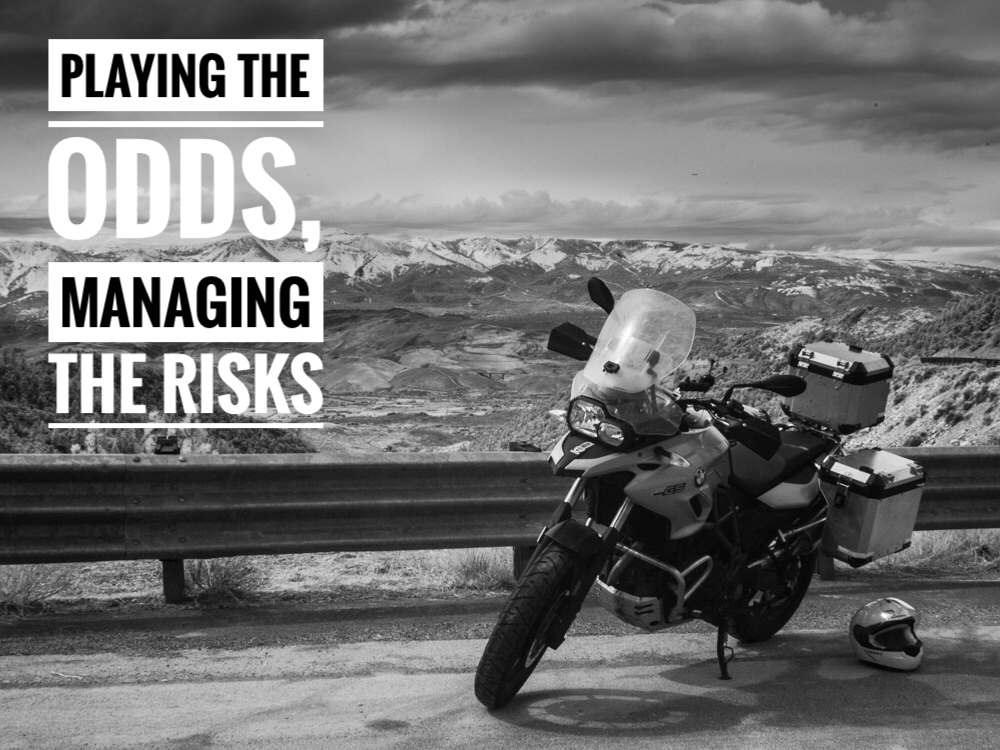
  • Playing the Odds, Managing the Risks

    Playing the Odds, Managing the Risks

    This week Motorcycle Awareness Month comes to a close here in the U.S. The timing coincides with seasonal riders surging to the roadways after a long winter’s nap. It’s an attempt to mitigate the risks to motorcyclists from drivers who aren’t used to seeing riders on the roads.

    Obviously this is a subject very dear to me. In previous years I’ve written about what motorcyclists want you to know (Part 1, Part 2, Part 3, Part 4) in hopes of cultivating awareness about our vulnerability on the road as well as our right to be there. This year I’m setting pragmatism aside because I’m utterly done with the “motorcycling is dangerous” song and dance.

    There are risks in everything we do and face every single day: driving a car, riding a bike, walking down the street, eating bacon double cheeseburgers, drinking too much alcohol, stress—the list goes on and on.

    Real and perceived risks

    The number of times in a month that I hear about another friend or friend-of-friend who has perished or been severely injured in a motorcycle crash is beyond disconcerting. And I am sick of hearing about the dangers of motorcycling when drivers violating our right-of-way (the “I didn’t see him/her” routine) is the most common cause of crashed between motorcycle and cars.

    Nearly as often, I hear about a friend or acquaintance who has suffered in an auto crash. Yet somehow that seems unavoidable. Tragic, but acceptable. It’s utter bullshit.

    The risks of driving, one of the greatest risks we face on a daily basis, far greater than airplane crashes and terrorism, are somehow just a part of life. My head spins at the incongruity—the false rationalization.

    And how about personal choices we make everyday that increase the risks from heart disease, the leading cause of death in the United States? When you criticize motorcyclists, have you considered the moment when a poor diet leads to a heart attack? How often have we experienced the crushing agony of a friend and family member dealing with cancer? Completely random and senseless. Merciless. Cruel. Utterly heartbreaking.

    Risks are everywhere. Sometimes tangible, sometimes not. Sometimes circumstantial, sometimes behavioral. But none of us should set aside enjoying our lives to avoid hyper-perceived risks and misplaced focus.

    Reasonable risk assessment and management seem to have taken a hiatus in our society. The chronic daily risks we are complicit in every day by choice seem perfectly acceptable. Yet punctuated, rare events that are dramatic, but highly unlikely, grab our attention.

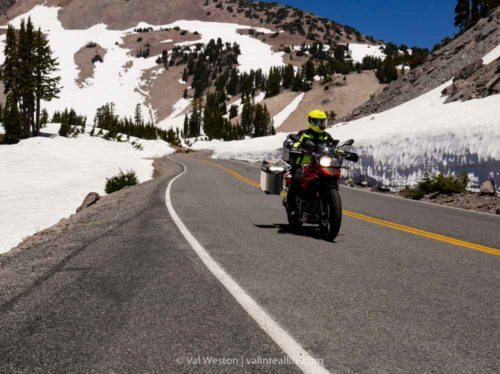
    val riding in lassen volcanic national park
    For me, this—travel, riding, exploration—is what makes life worthwhile. The reward for the risks. I won’t give it up because drivers won’t hold themselves accountable for their actions.

    Blame

    In January 2015, I was whole-heartedly and vigorously criticized when I suffered a motorcycle crash at the hands of an inattentive driver. Criticized by people who have no understanding of motorcycling. Somehow I was more to blame than the woman who “didn’t see me.” Someone who couldn’t be accountable for her actions compared to a trained and cautious rider. Really? A rider who was wearing full high-viz gear. In broad daylight. At low speed.

    You need to check yourself if you blame the victim instead of focusing on the true cause.

    I saw the driver who hit me. Why didn’t she see me? And how is that my fault?

    Do we have a responsibility to protect ourselves? Yep. I did that. In spades. Because I was not successful at avoiding becoming the victim of the crash does not put me at fault. 

    So let’s get back to what should be the first order of business — do no harm. We all have a responsibility to not hurt people through our actions or negligence. We all have a responsibility and obligation to pay attention when driving your car.

    It’s a truism for vulnerable road users like motorcyclists, bicyclists, and pedestrians that regardless of fault, we always lose an encounter with a car.

    You can make no mistakes and still lose. —Jean-Luc Picard

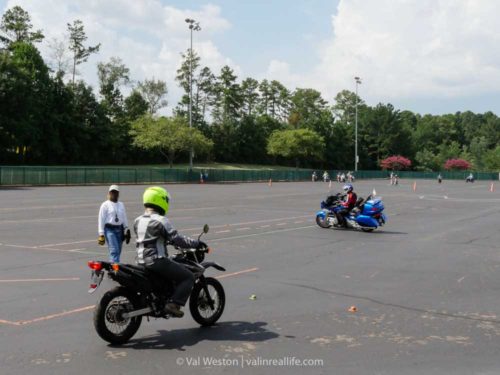
    val at an msf class - val in real life
    Me training at the Motorcycle Safety Foundation campus in Alpharetta, Georgia. Doing what I can to manage and mitigate the risks I accept.

    In spite of you

    Yet the ill-informed—the anxious—ask me why I got back on the bike.

    I say “Because I want to live boldly while I can. In spite of you.” In spite of you thinking you can text and drive. Or watch a video while circling the parking lot. In spite of your lack of training and awareness of other road users.

    There is no safety net, no magic bubble, no guarantees. I’m not going to bunker myself in my home, not living my life, only to become a victim of cancer and wishing I’d spent my time on this planet better. I could play it as safe as possible and still have a high likelihood of having my life cut short—by circumstance or someone’s negligence. So I protect myself as best I can with training, awareness, and proper gear because I know I’m at the mercy of your lack of concern for your task.

    In spite of you, I choose a life lived out loud doing what I love. A bold, beautiful life. An aware, awake, fulfilling life. On a motorcycle.

    Tough love

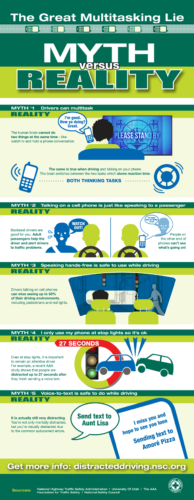
    Provided by the National Safety Council.

    So for you drivers out there, do your part. Open your eyes. Learn how to spot motorcycles, bicycles, and pedestrians.

    Pay attention to your decisions. Especially those that affect me while I’m riding safely, responsibly. There are honest, unfortunate mistakes in operating motor vehicles. Distracted driving is not one of them. Put the phone down. You’re not that good at multitasking.

    No one is.

    And your text or call is not that important. Think about it. Really think about it. Does that message really have to be answered right now? You aren’t that good a driver. You simply aren’t.

    We know distracted driving is a growing problem. You need to reconsider your ability to perform reasonable personal risk assessment if you think it’s ok to “multitask” while driving. Even for “just a second.”

    And when was the last time you actively worked to improve your driving skills?

    I’m doing my part

    I’m calling you out. Up your game.

    I do. I train. I pay attention. I practice improving my skills every time I get on the bike or behind the wheel. I’m not infallible. But If I screw up it won’t be because my face was buried in my phone or messing about with something else. I’m damn well working hard to be the best rider and driver I can be. And not because of the crash. I’ve been committed to it for a long time. Have you?

    No one should have to suffer for your lack of appropriate risk assessment or skills. Don’t be the person who destroys someone else’s life and then blame it on them.

    And riders, don’t grouse about cagers if you’re riding like a squid. You’re a small fraction of the motorcycling community but you’re giving us all a bad name. Just stop it.

    Don’t talk to me about how dangerous motorcycling is until you are the best driver on the road and have credentials to prove it.

    Until then, I’ll see you on the road. And let me be perfectly clear… I will see you.

    Will you see me?

    atgatt val - val in real life
    I work very hard to help you to see me. That only gets me so far. You can’t see me if you’re not looking.
  • Awake: Finding My Inner Thelma

    Awake: Finding My Inner Thelma

    I imagine most of you are familiar with the movie Thelma and Louise and its tale of two women finding their strength through a series of unexpected and escalating ordeals. In one of the most enduring scenes towards the end of the film, Geena Davis’ character, Thelma, says to Louise “I feel awake. Wide awake. I don’t ever remember feeling this awake. You know what I mean? Everything looks different. You feel like that too? Like you got something to look forward to?”

    Waking up

    It’s been over two years since my life and body were brutally and forever altered. And I think I’ve finally found the elusive peace I’ve been searching for since then.

    In the wake of the crash and other complicated life stuff that compounded the stress, the past two years have been more challenging than rewarding. It hasn’t all been miserable of course, but there’s been an underlying weariness and dullness even in the bright moments. I’ve had to dig deep into the depths of what fortitude I possess to manage all of it.

    Throughout this time I continued to do the things I knew I loved even when they didn’t necessarily fill me with the same awe and excitement as before. Those things—riding motorcycles, hiking, traveling, exploring—still felt good. Pleasant. Nice. There was happiness in them. But muted.

    In the last couple of months there’s been a shift. I feel like me again. I have genuine, deep delight in life once more—meeting new people, going new places, learning new things. I’m once again fully engaged in life with joy and amazement.

    Mental gymnastics

    From the beginning of my recovery process, I knew that being true to myself was crucial. In my head I knew I needed to anchor myself in what I loved before the crash. Emotionally though, that was an extraordinary challenge because pursuing those things didn’t always feel good or the challenges seemed physically overwhelming with my damaged body.

    In all of this time I expended a lot of energy dancing between forcing myself to focus on the positive and allowing myself to feel all of the inevitable anger, frustration, and grief. Make no mistake about the deep and lasting impact trauma of any kind has on someone and the burden of dealing with it on top of the other tasks of life.

    One of the underlying themes of being in that mental space is feeling incapable, lost, small. I’ve written about regaining confidence in riding but the larger truth is that my entire confidence as a person—who I am, what I want out of life, feeling relevant—was shattered.

    geiger grade - val in real life
    Holding on to what I love and giving myself a new start in Nevada.

    That all-encompassing self-doubt had broad implications, including making it a struggle to keep this blog going and all of the writing, business, and social media that goes along with that. A lot of the time I just didn’t care about keeping any of it going. I knew I love doing this but mustering enough enthusiasm was exhausting. With sheer will power I had to develop almost a blind trust that at some point life would fall back into place. I convinced myself that if I simply kept showing up and participating as best as I could, life would work itself out.

    There was no magic moment when that happened. Just enough fading of stressors, memories, and challenges. And enough time to put mental distance between myself and them. Enough time to figure out how to manage my body as it is now and still be able to enjoy doing the things I love. Enough time to come to terms with the pain and difficulty that are a daily part of my life now.

    Some might file this under “Time heals all wounds.” I don’t. I’ve learned to hate that patronizing, dismissive cliche’. Time gives you the space to cope and weave bad experiences into the fabric. Maybe time even fades the memories a little. But I would in no way call it healing in the implied sense that people often use that phrase. They imply that the healing is erasure.

    In this process, I also made a collection of choices that have helped me get to this point. The bulk were small to moderate decisions and re-prioritizing after asking myself questions like “Is this adding to my life?,” “I want _____; how do I achieve that?,” “What do I want more of? Less of?” Those little choices added up but there were big notable ones that provided the framework—getting back on the bike and moving to Nevada. Both were extraordinarily difficult and more worthwhile than I can articulate. I think it’s poetic that one represents holding on to a core value and the other giving myself a clean slate from which to rebuild.

    great sand dunes national park - val in real life
    The triumph of overcoming obstacles felt wonderful. But was always followed by dismay from the pain and exertion of the attempt.

    And so I find myself happy and vibrant again. Awake. Aware. Confident. Unlike Thelma who was unfamiliar with that feeling, I knew it before. I loved that feeling and I wanted it back. Badly. One of the overriding sensations of rediscovering it is relief. Profound, extreme relief. I’ll confess that there was so much of this time I thought I’d never get here, that I’d never get myself back no matter how hard I worked at it. That I wouldn’t be able to move beyond simply getting by. That my greatest loss of this ordeal would be to never have that feeling again.

    There were surges when I thought “This is great. I’m better.” Only to have that feeling fall away or get buried underneath a new round of challenges. Those waves felt good but the crash afterward continually undermined me. I felt like I couldn’t trust the positive surges. I knew I was getting there at the one-year mark but I began to fear there would be an upper limit. That I’d never fully be Val again.

    Of those who have spent time with me in the last two years, most would probably say I seemed happy and myself. I was never gone, just incomplete. Allowing myself to enjoy the good moments wasn’t about hiding my struggle or being disingenuous. It was about letting good moments be good and not carrying all of the painful weight of the last two years on my sleeve. That’s too heavy a burden for myself and the people around me. There was certainly plenty of talk with my closest friends who helped me through this. With the larger audience much of time I was simply tired of talking about it.

    Peace

    Despite being ok, I still struggle with the effects of trauma. I always will. But it doesn’t run my life anymore. Given the longevity of this process and the head-spinning ups and downs I’ve hesitated to announce “I’m better!”

    So why is today different? It just is. I can’t explain it other than it feels different. I feel light, free—in a way I haven’t in the last two years. I have the same sense of giddy excitement about doing the things I love that I used to. None of the events and struggles have been erased but in the deepest core of who I am I know I’ve made my peace with the last two years.

    I’m back, friends.

    I feel awake.

    lassen volcanic national park - val in real life
    It finally feels truly, deeply good to be in the saddle again.
  • Life After Trauma

    Life After Trauma

    Today marks an unwelcome anniversary: the second year since my near-fatal motorcycle crash at the hands of a negligent driver.

    I intended to write this last year on the first anniversary. It turns out I wasn’t ready. I knew at that point I’d be ok, but I still had a lot of processing to do. The trouble with trauma is that it requires processing for the rest of your life. It isn’t finite. But I’ve come a long way with a lot of hard work and attention to addressing it.

    Obviously I’m no doctor or therapist. I’m simply a person trying to navigate the cloudy waters of a life-changing experience. But now seems like the right time to circle back around and talk about some of my experiences.

    There is a lot of overlap in the concepts of dealing with trauma. I can in no way speak for all of the other kinds of trauma out there: abuse, neglect, assault, combat, death, divorce, and more. The list of ways we can suffer trauma is extensive. Each one is different and needs to be handled as such.

    Understanding Trauma

    val in real life
    It’s been two years yet it often feels like yesterday that I lay in the trauma center fighting for my life.

    Trauma is a conundrum. The medical community itself is still grappling with awareness of what constitutes trauma, how it alters us in the human experience, and the best practices in dealing with it. Which means for a lay person like myself to try to articulate the experience is daunting. But also necessary, I think.

    What seems clear from my minor research is that trauma fundamentally changes the brain. Emotional and physical responses to trauma and the lasting memory of it are involuntary. Those who are outside of the trauma looking in at the victim must understand that these reactions are not chosen, they are not manufactured, nor are they a sign of weakness.

    Here are a few things I’ve learned in the last two years. It’s by no means an exhaustive list but it’s a starting point of some things to keep in mind if you’re ever faced with the trauma of a crash (especially at someone else’s hands) or a similar dramatic injury.

    In the Aftermath

    Brene' Brown's Rising Strong on Amazon
    Brene’ Brown’s Rising Strong is available on Amazon.
    • Seek professional help. Right away. Even if you think you’re doing ok. There will be surprises as you move forward. I didn’t seek help until about six months into my recovery. Having an impartial, trained professional to help me navigate the magnitude of what I was facing would have been a great benefit earlier on. In my case, I chose a therapist who specializes in DBT (Dialectical Behavioral Therapy) which is based on mindfulness. It has been extraordinarily helpful in general, as well as helping me deal with everything related to the crash.
    • Understand grief, anger, and sadness will come in powerful, unexpected waves. The path is not linear. You will get caught off guard by strong emotions and reactions. That’s normal. You’ll need to develop techniques to manage your responses when they come. A professional can help you develop those techniques. That’s why getting help early on is so important. Having a bad day isn’t a setback, it’s part of the process. From The Science of How Our Minds Work:

      In trauma survivors … the parts of the brain that have evolved to monitor for danger remain over-activated and even the slightest sign of danger, real or misperceived, can trigger an acute stress response accompanied by intense unpleasant emotions and overwhelming sensations.

      From Brene’ Brown’s Rising Strong:

      …grief is like surfing. Sometimes you feel steady and you’re able to ride the waves, and other times the surf comes crashing down on you, pushing you so far underwater that you’re sure you’ll drown.

    • Tap into your support network. You’ll need help, emotionally as well as physically. For independent spirits accepting that help can be very difficult. The outpouring of support in the wake of my crash was overwhelming. I will be forever grateful to every single person who helped me in ways both large and small. When you’re used to living a large, adventurous life, the sudden and complete incapacity is crushing. But having people bring you food, take you to medical checkups, fetch your medications, shuttle your children to school, help you bathe, or simply just hang out with you when you can’t even leave your home is extraordinary. The bonus is having greater bonds with the people who help you. If you struggle with accepting help, keep this in mind from Rising Strong:

      In a culture of scarcity and perfectionism, asking for help can be shaming if we’re not raised to understand how seeking help is human and foundational to connection.

    • Minimize compounded stress. Along with the injury itself comes the financial strain of medical bills and possibly the inability to work. If your situation also involves legal matters that escalates the stress even more. All of these feed on each other. Seek whatever external help you can to manage some of those things for you. It’s important to pull as much stress off of yourself as humanly possible so you can focus on the healing and recovery tasks that others simply cannot do for you.
    • Build structure.  Having a framework of consistency reduces the crippling uncertainty that comes with trauma. From Building Resilience After Trauma: Lesson from Chile:

      A schedule and a tidy physical space provide safety for trauma victims to sort through their range of feelings, memories, and fears.

    great sand dunes - val in real life
    Getting back to what you love helps you reclaim your power.
    • Trust in what you know you love. Take steps to return to what you love even though it may not feel good at first. I know deep down what my core joys are: yoga, hiking, motorcycling, and travel. Even though participating in those activities was a struggle with pain and insecurity I knew I had to get back to them, that they were a connection to “me,” and would be a stabilizing force in my life. This offers something that feels like control when your world has spun so wildly off of its axis.
    • Read and learn. Create understanding about what you’re going through. It demystifies the experience. Knowledge is always empowering. Having resources helps break the process into manageable and actionable items instead of wandering in a state of overwhelmed confusion. While not directly related to a trauma experience, one of the tools that allowed me to make a huge leap forward is Brene’ Brown’s book, Rising Strong.
    • Find others. Trauma victims gain strength from each other and the shared understanding of what it means to be a trauma victim. Again, from Building Resilience After Trauma: Lesson from Chile:

      We become resilient when we break through our isolation and involve ourselves in our communities.

    • Don’t hesitate to change course. If the tools, professionals, and/or friendships you are using for support don’t appear to help, explore more options. If the people who are “helping” you are making you feel worse, keep them at a distance. It’s crucial to be surrounded by support. Every interaction, especially early on, can shape your recovery. This is not a time to be polite if someone is undermining your recovery, even unintentionally.
    • Keep working. It will be tempting to think you’re at the end of the progress you can make, especially further down the line when you’re tired of working so hard at it for so long. You may think “This is as good as it gets. And it really sucks.” Unfortunately it’s a really long haul but there is still more progress you can make. You’ll have to fight for it. Get more help. Or different help. But keep going.
    • Find an outlet. With some time, you’ll have processed enough of your experience to be a resource for others in a similar position. Helping others by sharing your experience creates empathy and combats the alienation that can come with trauma. You’ll need a certain amount of emotional distance from your trauma before that can happen. I knew I wasn’t ready a year ago but I know I am now. From Rising Strong:

      Hurt is hurt, and every time we honor our own struggle and the struggles of others by responding with empathy and compassion, the healing that results affects all of us.

      …writing about emotional upheavals for just fifteen to twenty minutes a day on four consecutive days can decrease anxiety, rumination, and depressive symptoms and boost our immune systems.

    • Change your expectations. This is a hard one with a long arc to achieve. Recovery doesn’t mean life becomes easier. Or that it goes back to what it was. Give yourself time to reframe your experience and know you won’t be the same person on the other side. I fought to get back to “me” for a long time before accepting I’m a different me now. The difficulty with trauma is that it marks a sudden change forced upon you, far outside the natural progression of changes we face throughout life. But it’s a change that needs to be absorbed. From Rising Strong:

      But in those moments when disappointment is washing over us and we’re desperately trying to get our heads and hearts around what is or is not going to be, the death of our expectations can be painful beyond measure.

    Parting Thoughts

    moto guzzi - val in real life
    Moving through trauma isn’t linear. Even two years after I was hit by a car, some days I own the intersection where it happened, some days I struggle to go through it, some days I avoid it altogether.

    I’m fortunate to have weathered this without depression overtaking me. But it’s been a battle on par with my physical recovery. To reconcile the role of a traumatic event in your life story without letting it define you requires some mental gymnastics. It’s a path that I’ll have to manage for the rest of my life. Again, from Rising Strong:

    The irony is that we attempt to disown our difficult stories to appear more whole or more acceptable, but our wholeness— even our wholeheartedness— actually depends on the integration of all of our experiences, including the falls.

    Our job is not to deny the story, but to defy the ending…

    I hope having these tips in advance is helpful if you ever find your world turned on its head like mine was on that Sunday afternoon.

    Coming Up

    This is a huge topic; one I originally tried to boil down to a single post. As it grew, I thought it more appropriate to split it. So next time we’ll talk about the other side of this… how to help when someone you love is the victim of trauma.

    great sand dunes - val in real life
    Visualizing what I wanted to get back to was a powerful tool.
  • Going Off-Road at the BMW U.S. Rider Academy

    Going Off-Road at the BMW U.S. Rider Academy

    I’m a fan of proper training. The value of learning from qualified instructors is not lost on me, particularly when it comes to photography and motorcycling.

    Unlike photography, proper motorcycle training has implications beyond enjoyment and mastery of the pursuit. Health and safety are at stake when honing your riding skills. That’s why I’ve spent so much time at the Motorcycle Safety Foundation campus near my Georgia HQ.

    I recently branched out, though, and ventured to South Carolina for the BMW U.S. Rider Academy’s Women’s 1-Day Off-Road Adventure Foundations course. It may be one of the most valuable things I’ve ever done for my riding and for myself in general.

    bmw rider academy - val in real life
    It was quite an honor to spend the day building off-road skills with these folks.

    Exercises

    Our day began with a short introduction in the classroom. Our coach needed to assess our skills and we riders needed a sense of camaraderie before riding together. The class was small, only three riders, including me. BMW’s intent for the course was to be all women, including the instructor. Unfortunately, the sole female instructor at the U.S. Rider Academy suffered an injury and couldn’t teach the class. We had Ricardo instead, along with Rob assisting. I was disappointed initially that it wasn’t all female but Ricardo and Rob quickly overcame my hesitation with their professionalism, approachability, and supportive attitudes.

    In the classroom, they set a tone of “Challenge by Choice” for the entire training course. Ricardo and Rob made it clear they were going to push us but we had the ultimate say in what we attempted and what we didn’t. We would build our skills on our own terms by moving just past the edge of our abilities and comfort zones. That was both exciting and a little frightening.

    bmw u.s. rider academy off-road school - val in real life
    Ricardo in action, demonstrating a solo lift.

    Getting started

    We began the hands-on part of the day with:

    • Balanced walk-arounds. This confidence-building exercise helped us get dialed into the weight and balance of our bikes by finding the balance point and keeping it there while we moved around it.
    • Raising the bikes on their center stands.
    • Working from both sides on mounts and dismounts.
    • Lift technique demonstrations, both solo and buddy.
    bmw u.s. rider academy off-road school - val in real life
    My steed for the day, an F700GS like mine but full seat height and no bar risers which was a slightly different geometry to master.

    On the bikes

    Session 1

    In our first riding session we tackled:

    • Moving around the bike side saddle. We worked through a series of positions beginning with placing a knee on the saddle, moving that leg to the opposite side of the bike, riding side saddle, then swapping foot positions so we could stand on the opposite peg, before returning to a normal seated position. Gonna keep it real here… when we started this exercise I thought I was in way over my head. I thought “If they’re starting with this, I’m in trouble. This class is way beyond my skill level.” Guess what? That warm up was super easy and a successful confidence-builder.
    • Slow riding. Refining our skills at low speeds, where most drops happen.
    • Trials stands. Getting as close as we could to a balanced stop before using the throttle to restabilize.
    • Weaves. Slow riding around cones with hard turns and learning where to position our bodies.
    • Circles. The coaches added this in to help us get past our struggles with how far we needed to move our bodies off the side of the bikes. After this exercise we went back to practicing weaves and were much more capable.
    bmw u.s. rider academy off-road school - val in real life
    Practicing camel humps with track stands.

    Session 2

    After lunch on the BMW campus, we got back on the bikes for:

    • Washboards. Understanding the limits of the bike’s suspension and how to handle it.
    • Ruts. Controlling the bike solely by using the pegs.
    • Camel humps (with track stands). Working through body position transitions in quick succession over humps. I really struggled with track stands even though I have pretty decent balancing skills on pavement. I can still hear Ricardo saying “That’s not a track stand! You didn’t stop!” With love and support , of course. 🙂
    • Enduro runs. A chance to ride through trees and unexpected obstacles not dictated by a man-made exercise.
    bmw u.s. rider academy off-road school - val in real life
    Rest breaks included South Carolina sun and plenty of snacks and drinks from BMW U.S. Rider Academy.

    Session 3

    After a brief break there was still more to come:

    • Another enduro run. Much longer and across the full campus, without knowing anything about what to expect. It was all new terrain to integrate the skills we’d been working on all day.
    • Emergency braking. I struggled with this more than I feel I should have. It was late in the day and I was tired. I initially mentioned to my classmates this would have been much more valuable earlier on. Afterwards, I realized that mastering emergency braking when completely exhausted was, in fact, the best time to do it because that’s when you make mistakes. And having it be second nature at your worst point was actually the goal of the exercise.
    • Trying other bikes. I rode a BMW F700GS most of the day. My own F700GS “Evie” is lowered and has handlebar risers. This bike was standard height without risers. At the end of the day, I got the chance to ride the F800GS as well as the R1200GS. I really shouldn’t have ridden the 1200. Can you say “Come to Mama”? I wished I’d been riding it all day!
    • Lifting. Our last exercise was a chance to practice lifting the bikes. We had some inadvertent practice during the day, of course. However, the opportunity to practice lifts as a focused exercise instead of rushing to clear the training course was very helpful.
    bmw u.s. rider academy off-road school - val in real life
    Our enduro runs put our newly-developed skills to practical use.

    Quality

    I was thoroughly impressed with the quality of the course. The instructors fully grasp that most of the challenge behind mastering these skills is confidence followed by understanding what these machines are capable of doing. The pace of guided progression through confidence building was spot on, especially with the overtone of “challenge by choice” set from the beginning.

    Our main instructor, Ricardo, is a motor cop and international BMW instructor. One of the hallmarks of a good instructor is the ability to deviate from the plan when necessary to give his or her students what they need. Ricardo is a very skilled instructor in that sense as well as an expert rider. Our course was also overseen by logistics dude Rob, who managed the mechanics of the motorcycles and assisted as an instructor. He was encouraging, helpful, and pushed us appropriately when needed.

    My classmate, Patty, describes the collection of obstacles and terrain as an impressive off-road playground. I like how she puts that. I certainly felt like a little kid riding with abandon that day! She adds that she enjoys the physical challenge and mental focus it requires to participate in the class. It’s an intense day in the saddle. And worth every minute.

    bmw u.s. rider academy off-road school - val in real life
    Practicing riding through ruts.

    What I took away

    • A massive boost in confidence. Riding on sketchy terrain builds skills on pavement and off-road and means you’re ready for all sorts of scenarios that are thrown your way unexpectedly. My street riding improved as a result of this class.
    • I know what skills I need to work on most now. Some of the exercises went well for me, others I’ll need a lot more time to master.
    • Using BMW’s bikes is the way to go. It frees you to push yourself without concern over damaging your own bike. That’s a huge benefit. It takes away many layers of mental obstacles in improving your riding.
    • This is a huge physical challenge: Off-road riding is a different beast in terms of the physical challenge it presents as a rider. While I did fine and was able to complete all of the exercises, boy I was sore afterwards! My bum limb, “Frankenleg,” presents an additional obstacle to my physical stamina. Towards the end of the day, I could feel it giving out from fatigue. But I wanted every ounce of this experience and I couldn’t allow it to hold me back. It became a battle of wills of the you-don’t-get-to-quit-now type, but I clearly need to work more intently on rebuilding its strength.
    bmw u.s. rider academy off-road school - val in real life
    Chasing Patty’s tail on an enduro run.

    Why women only

    One of the discussions throughout the day is why having a women’s-only class is important.

    Gary Hardin, the Chief Motorcycle Instructor of the U.S. Rider Academy at the time, says that they could have offered the standard one-day class but felt it was more important to directly address female rider concerns. So they invited women rider influencers to participate in a standard one-day course and give honest feedback. What came out of the focus group afterwards was a thumbs-up on the class content and structure but the desire for the addition of the last couple of exercises that were included in our course at the end of the day.

    So essentially, the women’s class is what is offered in the standard one-day, finessed to include more of what women riders are looking to improve. For me, while I don’t mind training alongside men, the dynamic is quite different. It’s often competitive and that’s not why I’m there.

    Being a minority in the motorcycling world, the opportunity to be surrounded by others who understand the distinct challenges it is to be a woman rider is valuable. The overtone of our small group was absolute respect for one other and acknowledgment that we’ve all had a different path to this point in our riding.

    bmw u.s. rider academy off-road school - val in real life
    Teamwork is required when a rider’s low-suspension bike gets hung on a hump.

    Thoughts from the students

    Patty, having taken the two-day course in the past, said:

    “Although I’m accustomed to riding with the guys, I thought it would be a nice change of pace to take a class reserved for women. It’s always fun to meet other women who ride and even better those who are interested in off-road riding. I enjoyed hearing other ladies’ experiences and opinions about gear, motorcycles, and travel.”

    My classmate Charlene was comforted by the knowledge that there would be others who understand where she was coming from in her return to riding after a couple of years off. She said she was excited by the idea that she had nothing to prove and could focus on getting back to something she loves.

    bmw u.s. rider academy off-road school - val in real life
    The R1200GS. Can I have one? Pretty please? This is a really sweet ride.
    [Update: I brought home my own 1200 in November, 2018. And I love it!]

    I want more

    Of course, given how much I enjoyed this experience, I asked Mr. Hardin if a two-day women’s course is in the works. He said he would love to see that happen if enough interest can be generated. Even beyond the two-day course, he would like to offer a class similar to their advanced off-road class in which they spend time off of the bikes giving travel tips for anyone wanting to adventure ride outside of the country. That particular class is only offered as an extension to graduates of the two-day off-road curriculum.

    Mr. Hardin added that not many know that the U.S. Rider Academy offers private one-on-one and group instruction. That means if you desire the female group dynamic but the course schedule doesn’t fit yours, you have the option of private instruction or arranging your own all-female training.

    While I’m glad my first course at the BMW U.S. Rider Academy was all women, I won’t be waiting around for the women’s two-day course to be offered. I’ve got too much to learn to let that hold me up. One course is never enough when you’re intent on mastering a pursuit. And I know I still have so much to learn and refine.

    Final thoughts

    In review-type posts, I typically like to offer suggestions for improvement, even when I enjoy the product or experience immensely. This time, the only aspect I’d like to see improved is pre-course information on what to bring, what to expect, etc. I give all other aspects of the course top marks:

    • The pace, structure, and content of the of the course are really well thought out, in my opinion.
    • The campus and obstacles were great.
    • We had plenty of opportunities for breaks, hydration, and snacks.
    • The machines ran well and Rob responded quickly to any requests to tweak clutch levers and what-not.
    • The staff was absolutely top-notch.

    But the biggest factor here is that BMW has taken the initiative to embrace the needs and challenges of women riders as separate from our male counterparts. It’s not that women’s concerns are better or worse, or more or less important, they’re just different. And given our minority in the motorcycling community, those considerations are often overlooked. BMW is acknowledging that. I’m a fan.

    Ok, you’ve made it this far! Here’s a little behind-the-handlebars glimpse of riding at the BMW U.S. Rider Academy…

  • Bringing Home the Baja Mañana Spirit

    Bringing Home the Baja Mañana Spirit

    I recently returned from my first trip to Baja, Mexico. Intent on living my life as well as I can in the moment right now, I rode my motorcycle 1,500 miles south from my home in northern Nevada to the town of Loreto, on the Sea of Cortez.

    Why travel?

    The benefits of travel are well known but hard to measure. For those of us who make travel a top priority—a lifestyle we build the rest of our days around—the travel inspiration quotes that litter the internet are truths. Social media may have turned those words into platitudes for the casual tourist or vacationer, but for us they capture the sentiment of why we are driven to explore.

    Whether casual vacationer, business traveler, or dedicated explorer, we bring something unspoken back with us from every journey, regardless of its purpose. Sometimes that thing is small; other times it’s life-changing. Each experience builds our character in some way. That experience can have a huge impact when we visit a place very different from where we spend most of our time.

    The mañana spirit

    Bajacalifornianos aren’t the only people who embrace the mañana spirit, but it is that mindset I’ve brought back home from Baja. Of course, mañana is “tomorrow” in Spanish and it’s an “it-can-wait” sense of priorities. It’s about embracing joy, peace, and balance first. It’s the antithesis of busyness and doing for doing’s sake.

    My first experience with this attitude towards life was during my initial explorations of New Mexico over 20 years ago. I’ve danced and wrestled with it since, unable to maintain the rhythm of it. This trip to Baja was different for many reasons, though. Foremost, over two decades since my first taste of the mañana spirit, I know what I’m about and what my time is worth.

    So after immersing myself in Baja’s bosom and watching her people, I think I finally grasp what it takes to live my life from that place. It’s the place where there’s no need to rush around frantically and no need for busyness. In this place I can keep my priorities straight. This is the place I can live a life that is rich and rewarding without being fancy or complicated.

    The slow, easy-going mañana spirit isn’t aloofness or lack of consideration, as it may seem to outsiders at first. It’s knowing when and how to be productive—being thoughtful about how you spend your time. On this trip, I realized that the mañana spirit is a kind of natural mindfulness, the thing I’ve been trying to make my second-nature mindset for years. It’s the elusive concept that so many of us use apps, books, classes, and therapists to try to master. In Baja, it’s just there. And it’s been my most significant lesson yet.

    The thing about the mañana spirit is that in the end, everything gets done that needs to be done. And everything else? Well, it didn’t need to be on the to-do list to begin with.

    cataviña baja restaurant - val in real life
    Gravel-floored roadside cafes in Baja offer life lessons if you give them the chance.

    When the mañana spirit meets a timetable

    On the return journey motorcycling north, I sat with my dear man in a tiny roadside cafe in Cataviña. It was supposed to be a quick taco stop since we had a lot of ground to cover and not a lot of daylight to work with in the short days of December. It was the only cafe for many miles. No cell signal. No gas station. Not much of anything by American standards, really.

    We were the only customers the entire time we were there. We sat and waited, listening to the sounds of the abuela chopping fresh ingredients just a few yards away. The sound of her knife thumping on the cutting board. The sizzle of the grill. Her lyrical voice as she chatted with her husband. We watched sparrows flit around inside the building, stopping to peck for food. Dogs wandered in and out of the cafe, their paws leaving prints in the gravel floor.

    While preparing our tacos, she also squeezed a glass of fresh orange juice for me. It ran down my throat in a smooth river, relief from the heat we’d been riding through that day. We took in the details of the cafe, building our Spanish vocabulary by reading the signs and listening to the conversation, marveling at the vast amount of Coca-Cola branding, and watching the ravens come and go from their perch on top of the tall cactus outside.

    It took quite a while to get our tacos. And they arrived freshly made, with care, by somebody’s grandmother. That lunch stop was about being immersed in our adventure in a way that we couldn’t do without embracing the mañana spirit. My parting reward that day as she pieced together my broken Spanish into something comprehensible was her patient smile and beautiful laugh, something I might not have gotten from her or noticed if I hadn’t taken the time to understand life in Baja.

    Adventure on, friends.

    baja taco - val in real life
    Intimate experiences are available everywhere in Baja if you give yourself the chance to understand the mañana spirit.
  • Forty-Five: Celebrating with Adventure

    Forty-Five: Celebrating with Adventure

    I’ve published a birthday post every year since 2011. It’s a reflection of my outgoing year as I consider the new year ahead. In that first birthday post, I confessed to my behind-the-scenes health issue. Little did I know how much worse things would get for me. It’s ok to laugh ironically, I promise. I have at least some sense of humor about it now. A pained humor, but humor none the less.

    Rereading about the last five years I can’t ignore that my body has been through a lot. Some things that weren’t blog worthy, along with the things I did share. Some issues are related to aging, but many lie outside of that—mainly substantial injuries.

    The details aren’t actually important but the big picture is that my body is one hell of a mess. And you know what? I don’t care. I’m going to keep doing what I do until I simply can’t anymore. And when I can’t do things the way I do now I’ll find another way. Because this is who I am and this is what I love.

    I don’t want stuff. I want life. To me that means exploring, seeing the world, meeting people different from me. That’s why this year I’m celebrating with adventure. This is the spirit of eating the cupcake and that’s why I’m currently headed to Baja on my motorcycle.

    I turned 45 today. I’m not waiting until a “big” birthday—one with a zero. I’m doing it now. Because I know too damn well there’s no guarantee I’ll see 46. I feel I’ve dodged some pretty big bullets lately and I’m not going to squander my chance to make the most of my life. None of us know what’s around the bend, do we? So grab life, embrace it, live it.

    In the big scheme of things, year 44 for me has been one of transitions and making bold decisions for myself. That’s the long play—the choices that lead to the life I want in the long term. Having launched a new chapter in my life, and having survived a lot of things in the last five years, I’m celebrating the right now of still being here and in fairly (I use the term loosely) good health at 45.

    I’m doing this now before I hurt too much to do it anymore. Or I’m not here to do it at all.

    Eat the cupcake, my friends.

    birthday - val in real lie
    As part of weaving the tapestry I want, today I woke up in Death Valley. This place has grown more and more important to me in the last few years, on par with the Great Smoky Mountains and Great Sand Dunes. I’m eating the cupcake. And savoring it.

    The Birthday Series

  • Motorcycling Through Northern California and Southern Oregon

    Motorcycling Through Northern California and Southern Oregon

    “Shit!… are you kidding me?!? I don’t know about this. Shit-shit-shit-shit-shit!” (Or possibly stronger oaths.)

    Those are the words I gasped in my headset to my dear man as the pavement suddenly deteriorated to something formerly known as asphalt. The sand and gravel covering it didn’t help matters. The unexpectedly unruly terrain had my bike dancing over its surface like a slapstick comedian trying to walk on ball bearings and banana peels.

    This was my introduction to the Coos Bay Wagon Road in Oregon that he had joyfully selected as part of our route earlier that morning.

    “Do you want to turn back?” he asked.

    “I don’t know,” I said as my motorcycle wriggled like a restless toddler underneath me.

    I took a few deep breaths and got rational. No. Backtracking was counter-productive. Suck it up. Ride. In spite of my confidence issues since last year’s crash, this isn’t that big of a deal. I reminded myself that I know how to do this. The situation is simply a surprise. How far could it be on this old logging road anyway, right?

    The ball-bearings on glass scenario shifted to dirt and gravel. But with tight twisties. And then I found myself staring wide-eyed at a massive logging truck barreling at me around a blind corner on the narrow road.

    More epithets ensued, of course, as I quickly corrected for the situation.

    Those were only to myself this time. To my dear man, it was a calm “There’s a logging truck coming. Watch out.” That was the mom instinct kicking in. Finally. Project calm while internally freaking out. And not letting on how dicey the situation was for me.

    It was then that I realized I was outriding him. He was not in my mirrors. I slowed to close the gap but he was way back, something that’s never happened before given his level of riding skills compared to mine. But on a new bike not equipped for this riding; a low sport-touring beast with no skid plate and a wide rear tire that might as well be a bouncy-ball on this terrain. My BMW F700GS was the better bike for the job, in spite of my lesser skills.

    But that was more than mid-way through a 1,300-mile trip that started 4 days earlier.

    coos bay wagon road - val in real life
    The challenges of the Coos Bay Wagon Road forced retreat and rerouting — and a pause to check the integrity of our steeds after the effort.

    A change of plans

    So what do you do when your original plan for a motorcycle trip is waylaid by extreme temperatures and wildfires? You reroute, of course. That’s how I found myself wandering through northern California and Oregon instead of moseying my way south through the eastern Sierra.

    The Independence Day holiday was approaching and we anticipated increasing traffic as the weekend approached. Our goal was to escape the brutal desert heat but avoid the building holiday traffic.

    Not having ridden much in the west, this is all very new and challenging for me. I’ve been working on my skills on day trips in the eastern Sierra but the intensity of a seven-day trip of twisties and grades far more intense than in the east forced me to up my game considerably.

    lassen volcanic national park - val in real life
    The riding in Lassen is nothing short of astounding. Several months later, my breath still catches thinking of the drama and beauty.

    The route

    My lackadaisical trip (yes, only 1,300 miles in seven days) wound from Carson City, Nevada to Eureka, California up to Coos Bay, Oregon, then back east around Crater Lake before returning to northern Nevada.

    All in all, an excellent riding route. The Coos Bay Wagon Road was initially daunting but I eventually found my groove and ended up enjoying the ride. My dear man was having less of a good time. When we reached pavement again we felt triumphant. Then the road  reverted to living up to its name, and we had to make a decision.

    After chatting with a local and finding out we were looking at 20 more miles of slow-going, messy terrain, my partner gave that route a big thumbs down. By then, my tune had changed and I was kind of digging the idea of some more dirt. But it wasn’t worth risking damage to his bike, which isn’t designed for this kind of riding. Its low clearance on a rough road made the likelihood of busting his oil pan very high. And that would put an end to the trip. So we ended up backtracking to stay on more established throughways.

    Keep in mind, this is the guy who looked at his 10-year-old map and said, “Hey, let’s try the wagon road. It’s probably paved by now.” We did consult Google Earth and saw plenty of blacktop. But we didn’t check the entire length of the road. Adventure travel. 🙂

    hwy 101 oregon - val in real life
    Riding up the Oregon coast on Hwy 101 proved to be extremely challenging with erratic, strong winds. But this is still a spectacular ride.
    crater lake overlook - val in real life
    Taking in the view of Crater Lake for the first time with my dear man.

    The challenges

    You know I’ve got some serious road-trip cred in my trusty Subaru Forester and while there are some overlapping challenges, motorcycle trips require an extra level of badassery. Contending with exposure and vulnerability make a two-wheel adventure a very different beast from a car journey. The truth is it doesn’t matter what kind of trip you’re on, there are always challenges. This is life, yes?

    For this particular excursion, beyond still getting familiar with western riding, here are some of the more “memorable” challenges:

    • The heat in the valleys in the first two days made every mile feel like three or four. We fought to stay hydrated and keep our minds sharp in the numbing heat. It was soul-sucking.
    • We hit a number (ok, a lot…) of construction zones. The kind where you can wait up to 30 minutes for a pilot car. On scorching black asphalt in full gear, you can imagine the discomfort. At one point we had to park our bikes on the shoulder and scramble to the paltry shade of the only pathetic, scrawny tree in sight for a scrap of shade so that we didn’t roast.
    • Oh, Oregon, you do know how to blow a motorcycle around. I’m no stranger to intense weather and wind on the bike but the Oregon coast takes the cake on unpredictable, erratic winds. Gusts shifting around you constantly means you don’t know which direction the next blast is coming from. That kind of riding takes its toll. By the time you’re off the bike for the day, you feel like you’ve been in a boxing ring getting pummeled for hours on end.
    • My western bike, a gorgeous BMW F700GS, isn’t quite yet dialed in on ergonomics like my darling Moto Guzzi (“Nina”) in Georgia. That means fatigue from poor positioning; mainly throttle hand cramping and numbness. That will tire you out quickly. Hence the only 1,300 miles in seven days.
    • The heat and fatigue contributed to exhaustion that kept me from being productive at night. I know that’s not an issue for most folks out for a jolly trip, but it’s a reality of my blogger life and it became a point of frustration.
    coos bay wagon road - val in real life
    Imagine my ironic laughter hitting yet another construction zone… on a remote logging road in rural Oregon. I can’t help but think the construction gods were unhappy with us.
    Even in a Crater Lake National Park we hit challenging road construction.

    The rewards

    Of course the reasons we adventurer-types do this is for the rewards; the groovy discoveries along the way.

    • It was my first visit to Lassen Volcanic National Park. This not-well-known park is breathtaking and includes some seriously fun riding. I’m bookmarking it for much more exploration in the future.
    • This trip also took me to Crater Lake National Park for the first time. By the time we arrived, the holiday crowds had already descended on the park. It was a madhouse. Another bookmark set for better timing.
    • We found several charming mom-and-pop motels. Complete with actual, honest-to-goodness keys to the rooms and owners running the front desk. And a retro mountain resort where time appears to have stopped in the 1970s. Very old school but fun.
    • We found unique, yummy places to eat. Local breweries, hamburger joints, cafes — they were ripe for the picking. I will admit to putting on a few pounds on this trip. Totally worth it.
    • All along the way, we met great people. Being on motorcycles just seems to make you more accessible and both riders and non-riders always love to chat about where you’re going.
    • The riding was phenomenal. I love my mellow, southern roads but the exhilaration that comes with the terrain here makes the heart pitter-pat.
    lassen volcanic national park - val in real life
    I don’t know that I’ll ever stop gushing about riding in Lassen Volcanic National Park.

    Would I do it again?

    Yep. Absolutely. Great roads. Great riding. On a second go, I would either compress this trip down to five days or add on some miles to make it a fuller seven days. And just know what I’m getting into on the Coos Bay Wagon Road in advance. Then attack it with gusto!

    crater lake national park - val in real life
    My first view of the iconic Crater Lake in Oregon. Despite the bustling holiday crowds , there was no resisting wrestling the infrared camera from my panniers to grab a quick shot.

    Some more random images from a crazy motorcycle adventure!

  • Motorcycling: A Metaphor for Life

    Motorcycling: A Metaphor for Life

    Throttle therapy is an amazing thing. Lately when I’ve been out on the bike to clear my head, I’ve been musing on how much motorcycling is a metaphor for life. The three concepts that come to mind are:

    1. Look where you want to go.
    2. Avoid target fixation.
    3. Lean and accelerate.

    Here’s the skinny for my non-rider friends.  And for my rider pals who may not have considered this.

    Look where you want to go

    look where you want to go - val in real life
    Focusing where you want to go instead of the sea of chaos surrounding you is crucial in motorcycling and life.

    Any decent motorcyclist will tell you that one of the single-most important concepts in riding is “Look where you want to go.”

    Seems simple, yes? It isn’t. Keeping your eyes up and pointed towards your intended path… even when your handlebars may not be, is a counter-intuitive concept.

    For new riders, it’s a huge leap to get past worrying about what’s right in front of your wheel at that moment. To keep your long-term path in sight, understanding that near-sightedness leaves you scrambling and unprepared for each upcoming decision, and learning to trust that the bike will follow your eyes is the key to successful riding. When you learn to keep your eyes up and trust your path, the ride flows easily.

    The same can be said for life. Keeping the big picture in focus and making certain the things you do each day further that goal are what makes for a happy life. “Look where you want to go” rather than scramble frantically and unhappily through each day.

    Target fixation

    target fixation - val in real life
    On the road, and in life, there are countless “deer-in-the-headlights” hazards we have to avoid.

    The counter to “Look where you want to go” is target fixation. It’s a visual hazard or distraction that a rider locks onto and can’t look away from: debris, roadkill, oncoming car, pothole, etc. And guess what? You may not want to go there but you’re looking at it. You’re fixated. And that means you’re going to go where you eyes are pointed… directly into it.

    Have you ever been so fixated on something in life that you failed to see or understand other things that were going on around you? Have your ever ruminated on a bad situation or unhealthy goal so much that you couldn’t get on with your life? That’s the life equivalent of target fixation.

    Keep those hazards and obstacles in your peripheral vision. Notice them and make smooth adjustments to avoid them but don’t ruminate or fixate on them.

    Lean and accelerate

    sharp curve - val in real life
    When life throws you a sharp curve, lean in and crank the throttle!

    One of the joys of riding is gliding through the twisties. The rhythm of dancing through curves is unlike anything else. But the process of doing that well involves another counter-intuitive riding concept — to lean harder and crank the throttle to make the turn.

    Our human brains are hard-wired for fear. Our instinct when faced with a turn, especially one we’ve hit a little too hot at the outset or the radius changes suddenly, is stiffen up, go for the brakes, and pop upright. That’s the exact wrong thing to do. That knee-jerk, fear-based reaction will make for a bad day on two wheels.

    Instead, leaning harder and giving the bike more throttle is the answer. Braking causes a loss of traction and the slower speed means less stability. And suddenly pulling upright causes you to lose your line for the turn because leaning is what allows the bike to navigate the radius.

    I’ve come to learn that, in life, sabotaging my momentum and direction out of fear is the same thing. So when you’re navigating the turns in life, stay off the brakes and dig in!

    The big picture

    For me, motorcycling has become an enlightening and empowering necessity in life. It reminds me to focus on my path, keep distractions at bay, and keep moving forward.

    Adventure on, friends!

    lassen volcanic national park - val in real life
    When you keep your head in the right place, beautiful things happen!
  • Carson City Motor Cop Competition

    Carson City Motor Cop Competition

    Each year, the Carson City Sheriff’s Office hosts a motor officer training challenge. This year marked the 13th anniversary of the event, designed to bring motorcycle officers together for friendly competition, training exercises, and community connection. The venue, Mills Park, proved to be a fantastic site to be able to see all of the action brought by motor officers in Nevada and California.

    motor officer doing drills - val in real life

    Mad skills

    The marquis event of the Motor Officer Training Challenge is the timed course. Friday is a practice day for the timed course while Saturday was the competition itself.

    For a motorcyclist, watching both days is a treat. The practice day is almost a free-for-all with multiple riders on the course at the same time. Watching them ride together in tight maneuvers is astonishing and exhilarating. And with each trial round, you can see them run the course faster and faster, creating quite a lot of anticipation for how fast they’ll run in the competition.

    motor officers doing drills - val in real life

    As for competition day itself, the bustle is a bit slower with only one rider on the course at a time. But with that you get to focus on the whole of the course as they navigate the cones, fighting for a fast time.

    What makes the vibe of the competition so compelling is the camaraderie of the riders, all pushing themselves to do their best, but also supporting each other in their triumphs and foibles. Because in the end, this event is about training and improvement to stay safe on the road.

    motor officer on ramp - val in real life

    Seeing them in action, you realize you’re watching some of the most skilled riders in the world. The maneuvers they accomplish on huge bikes at low speeds are phenomenal. It’s a reminder of what the bikes are capable of doing with a subtext of knowing the riders’ lives depend on top-notch skills.

    For more news from the event, head on over to the Carson City Sheriff’s Office Motor Unit Facebook page. They’ve got great photos and videos of additional Extreme Motor Officer Training Challenge events like tether and Last Man Standing.

    motor office doing drills - val in real life

    Reality check

    On a more somber note, much of the sentiment of the event was for the loss of San Jose motor officer, Michael Katherman, on June 14th. He was killed while on duty when a car turned left in front of him. As you know, I have all-too-familiar experience with that myself. Fortunately I survived, if barely, and now quite a bit worse for wear.

    Here’s the thing: when the most skilled riders in the world are being killed in these scenarios, I have to remind drivers again, that being aware of all road users is your responsibility.

    nevada highway patrol motorcycle trailer - val in real life

    For those who continue to dismiss motorcycling as dangerous instead of acknowledging the bigger problem, I’ll say it yet again. No. When responsible, defensive, highly-trained riders are being killed, you are what’s dangerous. Most motorcycle vs. auto crashes are attributed to driver error. That means driver training, education, and awareness is the weakest link.

    Please do your part. Learn. Look twice. And then again. Make sure you’re actually seeing, not just paying lip service to attentiveness with a quick, disengaged glance.

    For more information on how you can do your part on the road, check out my series of what motorcyclists want you to know about road hazards we face, negative perceptions we encounter, how to share the road with us, and why we do some of the things we do on the road.

    motor officer doing drills - val in real life

    For your enjoyment

    Obviously this is an emotional subject for me. So on a lighter note and stepping back off my soap box, here’s a video of the event. I hope you find these officers’ skills as inspiring as I do.

    Adventure on, friends!

  • Embracing Community with Horizons Unlimited

    Embracing Community with Horizons Unlimited

    When I attended my first Horizons Unlimited Travellers meeting in April of last year, I didn’t know what to expect. It ended up being a delightful feast of adventurous souls, practical knowledge, and the beginning of beautiful friendships.

    It was a no-brainer then, to dart off to to the Horizons Unlimited North Carolina event last October. Held at the Iron Horse Motorcycle Lodge near Stecoah, I set out with the promise of connecting with many more experienced adventure travelers and seeing what I could learn.

    Horizons Unlimited
    The cozy grounds of the Iron Horse Motorcycle Lodge lend themselves to relaxing.

    The North Carolina travellers meeting proved to be surprisingly different from my first experience in Virginia and equally delightful. The venue is smaller so there aren’t as many presentations or attendees but connecting with other travelers is more intimate.

    As I grasped how varied these get togethers could be, I realized that’s the joy of them. They’re held all over the world and each one has its own flavor.  Reports from friends who’ve attended other travellers meetings confirm that it’s never the same experience twice. Different places, different attendees, different presenters, and different organizers make each one unique but still under the umbrella of the larger motorcycling community.

    Horizons Unlimited
    Camping at the Iron Horse Motorcycle Lodge.

    In the end, that’s what this is about — community centered on a common passion. This is where we can share our triumphs and challenges with people who understand. It’s where we can talk shop with people who care about motorcycle travel as much as we do ourselves. It’s about focused time with your tribe.

    And that’s why I’m heading back to the Virginia meeting this month. Since I’ve attended at that location before, I know there will be the comfort of familiar friends but also the intrigue of the new and unexpected. And I actually get to ride this time! Which is awesome. 🙂

    Horizons Unlimited
    Sam Manicom had us enthralled with his tales of travel in Africa.
    Horizons Unlimited
    Shared tales of travelers are part of the connection at Horizons Unlimited.

    Making the connection…

    Looking for a meeting near you? Head over to the Horizons Unlimited site. Don’t see one nearby? Then make it an adventure and go to one far away. Or start one in your area!

    For more images from my time at Horizons Unlimited travellers meetings, check out my Flickr album.

    Adventure on, friends!

    And now for your moment of green…

    Horizons Unlimited North Carolina - Val in Real Life
    Cruising my way through North Carolina with a smile on my face.
  • A Motorcyclist Wonders… Can You See Me Now?

    A Motorcyclist Wonders… Can You See Me Now?

    It’s no secret that, in spite of a lot of effort by motorcyclists to remain visible while riding, the all-too-common scenario of “I didn’t see you!” is still the predominant reason riders are involved in crashes.

    In the UK, there’s a motorcycling acronym: SMIDSY. It stands for Sorry-Mate-I-Didn’t-See-You. It has a flippant tone to it, but this is a very real issue for riders. It doesn’t mean we shouldn’t be riding; it means drivers need to step up and be aware of all road users.

    As you know, in spite of training, awareness, and hi-viz gear, last year I was a victim of SMIDSY. Far more than a SMIDSY “Oops!”, it nearly killed me. I’m a testament to modern medicine to still be here and still have my leg.

    As I returned to riding, I had to start from scratch since my bike, all of my gear, and most of my confidence was destroyed. I’ve already talked a bit about the process it took to get back to riding… everything from choosing a new motorcycle to the reality of getting back in the saddle.

    Since my return Nina and I have put in over 5,000 miles together. However, she’s anything but hi-viz with her sleek, black look. As pretty as she is, I’d rather not die for vanity, so I’ve had to up my visibility game.

    So with that preface, here’s the new gear setup that I hope adds to my motorcycle safety…

    Hi-Viz lid…

    motorcycle safety - val in real life
    My all-black Moto Guzzi V7 Stone needed some brightening up with a Schuberth hi-viz helmet and an Olympia Switchback 2 summer jacket.

    I went with a full yellow hi-viz helmet again. This time though, I opted for a Schuberth modular C3 in hopes of some wind-noise improvement over my previous HJC helmet. While I’m very happy the HJC saved my life, Schuberth has a fantastic reputation, especially for noise control. That comes with some sticker shock but having already been hit, it seemed a worthwhile investment.

    Having said that, to the casual observer the helmets look no different really. I often get the comment by passers-by — “Everyone must see you!” — when I’m wearing it. What can I say? In a few-second interaction with a stranger, it’s usually “You’d think…” or “You’d be surprised…” Richer conversations allow me to help drivers understand what riders really need them to know about motorcycle safety.

    Jackets…

    It was summer when I began riding again. Even though I had a jacket that wasn’t hi-viz, I bought a new one that was. Admittedly, at first I was cynical since hi-viz didn’t save me from being run over. After some time, I realized that when you take precautions, you actually never know what you’ve prevented. So I went in for an updated version of my Olympia Switchback, the hi-viz Switchback 2.

    Eventually I also replaced my hi-viz Olympia Ranger winter jacket with the same version that was destroyed in the crash. As I dove back into researching gear, Olympia was still my muse. When it comes to women’s riding gear, they’ve got it dialed in. I love the cut, adjustability, and design of their jackets.

    For an example of the impact of hi-viz, check out my video from an MSF (Motorcycle Safety Foundation) course I took with my friend, Hassan, last November. From the 1:40 to 1:50 mark, you can see the difference his hi-viz jacket makes. I know I certainly appreciate being able to easily see riders, cyclists, workers, and pedestrians when they’re wearing hi-viz.

    More ways to improve motorcycle safety…

    Historically, I’ve only ridden with my side cases on the bike when I needed the storage space for longer trips. These days though I find myself riding with them most of the time. They add size, creating a bigger profile for drivers to see. And this go-round I added reflective hi-viz tape to the back of my cases for improved visibility from the rear.

    I also don’t always wear a hydration pack while riding but in the brutal months of a Georgia summer, I opt for a Geigerrig 710 in citrus. That allows me to stay hydrated without undermining the hi-viz on my jackets.

    motorcycle safety- val in real life
    My hi-viz strategies… reflective tape, jacket, helmet, and hydration pack.

    Lights!

    The most pronounced improvement in my visibility came from adding Skene lights to Nina. I discovered them thanks to a fellow rider at Horizons Unlimited Virginia last April. Skene brake lights flash in various sequences to draw attention and each light set acts as extra turn signals if you add the “Booster” option. The lights can also be set into different modes to serve as hazard lights if necessary.

    For my setup, I added the Skene “P3” red rear lights (click for video) at the license plate. For the front of the bike, I opted for two amber sets of their “Photon Blasters” (click for video) on the forks — one set facing directly forward and one set to the sides. I mounted  them low on the front forks to create a larger visual triangle with the existing headlight and turn signal lamps.

    Let me tell you, these lights do the trick. I get a lot of comments about how visible I am. If you miss seeing me now, you need to not be driving a car.

    Some important notes about Skene if you’re considering their products:

    1. They offer a Safe Rider Rebate if you show them your certificate of completion in a safe-rider course.
    2. Fork mounting brackets will be up to you to purchase separately for installation due to the variability in motorcycles and your personal choices in how you want to mount them.
    3. As a shout out to Skene customer service, I will note that one of my lights had a few LED segments that failed. They instantly sent me a replacement, no questions asked.
    4. I’ve not been compensated by Skene in any way for this post. I simply think they offer great products and I want my fellow riders to live to ride another day. 🙂
    skene lights - val in real life
    View of Skene lights from the front. With the LED lights down low, they create a larger visual pattern with the bike’s headlight and turn signals.
    skene lights - val in real life
    Close up view of the Skene Photon Blasters in amber on Nina’s forks.
    skene lights - val in real life
    Rear Skene light setup alongside license plate. The flashing pattern of the lights is actually visually uncomfortable and gets driver’s attention.

    And yet still…

    I’m going to get very real here. Non-riders might feel a little uncomfortable. I want you to because I need you to examine your habits as a driver. So here goes…

    The expense and effort many riders go to to be seen is substantial. And beyond gear, I’m constantly training and practicing to improve my defensiveness as a rider. I don’t personally know any drivers who aren’t also riders who truly work on their piloting skills. Maybe that’s the problem. At the very least, please take some time to read through some of the things riders need you to know.

    Remember, I’m doing everything in my power to help you see me and avoid bad situations but that the hard truth is that it’s irrelevant if you are distracted while driving or are unprepared to deal with road users that aren’t automobiles.

    Drivers, you are in control of a deadly weapon. Please act accordingly. I’m doing my part. I need you to do yours.

    And now for your moment of green…

    death valley - val in real life
    Taking a cue from nature on how to stand out!
  • On Being OK

    On Being OK

    Today is the anniversary of the crash that changed my life.

    And yesterday I was out riding my motorcycle. It was an eerily similar scenario as far as weather and timing go: A severe-clear Sunday afternoon. Roughly 50 degrees. Streets somewhat quiet by metro-Atlanta standards.

    Near home, I stopped into a store to deal with some life stuff. I had to wait for a bit. No problem, except for the heightened awareness of how close-by I was to “the” intersection. The place where I was hit by a car, and nearly killed. Feeling out-of-sorts, I noticed a familiar headlight directly outside the door. Yep, there sat the exact make and model of the car that crushed my leg and much of my life one year ago.

    Again, I found myself uttering an involuntary, ironic laugh. I thought to myself, “Seriously?”

    With some mental gymnastics and the use of some coping skills I’ve learned in therapy, I managed the situation. Then I rode home with renewed fervor, determination, and a sense of burgeoning freedom from the ghosts of this past year.

    Yes, my leg is still trashed. It always will be.

    My life is forever altered. This will always be with me. The scars are a constant reminder.

    I have not yet found peace. But I see it on the horizon.

    There hasn’t been one defining turning point in this process. There have been several hard-earned shifts in the path.

    I’ve battled to maintain my fierceness over the last year. After rising above yesterday’s challenge, though, I finally know I’m on the downhill side of the bumpy road through trauma. I win.

  • Forty-Four: Eat the Cupcake

    Forty-Four: Eat the Cupcake

    Tomorrow marks my forty-fourth birthday. I view birthdays as personal new year: a time to reflect, assess, and consider the previous year. Birthdays are usually safe from the turmoil of other holidays so it’s easier to be more thoughtful. This year, more than ever, I’m grateful for the amazing support of the people who love me. And for a fabulous therapist. Just keeping it real, y’all.

    Sitting down to write this annual birthday post and looking back at this particular year, I go a bit numb. I like that better than the flood of emotions that still overwhelms me some days. This year has been one of extraordinary pain. And stress. It has been a roller coaster of raw emotions that run the gamut between hope and despair. Navigating those extremes on nearly a daily basis for almost a full circle around the sun so far has taken its toll.

    But let’s back up

    I never wanted to be the person who woke up one day realizing she’s old and didn’t really live her life. Or develops a terminal illness before trying to live a life in earnest.

    When I was diagnosed with a pituitary tumor just before my 40th birthday, I realized I wasn’t being true enough to that mindset. I wasn’t achieving the balance I wanted. The tumor was a highly treatable situation, if still difficult and unpleasant. It felt like I’d dodged a bullet and I didn’t want to squander my reality check. With careful attention, I’ve managed to strike a better balance in my life since then. As a result, I’ve had some incredible experiences.

    And then this year, I was brutally and suddenly cut down to my core. It’s left my body feeling old and broken. Oftentimes my spirit feels the same way.

    I can tell you I’m very glad I did some epic things in the time between the tumor and the crash. Unfortunately, now that I see what my permanent limitations are, I will simply never be able to do some of those things again. Certainly not in the same way or at the same level. Even daily tasks present new challenges.

    Since I resolved to be more deliberate in directing my life’s path, I also created and nurtured the mindset and lifestyle that has helped carry me through this ongoing recovery. I’ve needed every drop in the bucket.

    Eat the Cupcake

    A recovery of this magnitude takes a lot of time. I’m still working on both the physical and emotional aspects of that. And I will be for a quite a while longer before I entirely recalibrate.

    The day before Halloween, I was having a very, very bad time dealing with the emotions that come with life-changing trauma. But I needed to pick up a cake at a local bakery for a friend and I was trying to keep moving forward with my life in spite of being overwhelmed.

    Another woman was there picking up a cake as well. She was having an amusing debate with the clerk about whether or not to get a cupcake for herself. With a bit of wink and nudge, she looked at me and said:

    “You never know, I could get hit by the bread truck tomorrow.”

    I uttered one of those ironic, involuntary, guttural laughs. I had to summon every ounce of composure and strength I possess to hold back the tears, grief, pain, and frustration that wanted to surge forth like a wildfire. After a moment (or maybe ten…) I smiled at her and said:

    “Trust me, eat the cupcake.”

    Afterward, I went to my favorite outdoor respite and sobbed helplessly for I don’t know how long, consumed by all the emotions of everything about this ordeal up to that point. When I relayed the story to my therapist, even she winced at the thought of this little exchange, knowing how difficult it was for me.

    The woman, of course, had no idea she’d just said that to someone who’d recently actually been hit by a car. It was simply an off-hand remark expressing something we all know but don’t necessarily honor in the big picture of running our lives—that it can change or end at any moment.

    The bigger picture

    In spite of this, you might be surprised that I’ve never been a fan of the “Live every day like it’s your last!” message. Let’s face it, that’s not realistic or healthy. We all recognize in theory that our lives are fleeting but we still have to do the laundry and pay the bills. Not every day can be epic. A life well-lived has a rhythm. One that requires you to protect your future while not banking on days that may not come. That’s the challenge.

    I do believe in keeping your bucket full, though. That’s the emotional savings account for hard times.

    So eat the cupcake. Maybe not every day, but when it makes sense to get your life back in balance.

    Live large and adventure on, friends.


    The Birthday Series

  • Overland Expo East 2015

    Overland Expo East 2015

    Even for adventure travelers, the conditions were somewhat daunting for this year’s Overland Expo East event in North Carolina. The rain and winds were the courtesy of Hurricane Joaquin. At our location near Asheville, we were on the outskirts of the storm but the impacts were still significant. It had many of us longing for the less-challenging conditions of Overland Expo West AKA “Snoverland Expo” back in May. That’s saying something.

    Overland Expo East - Val in Real Life
    My soggy entrance to North Carolina was only the beginning.

    The Venue…

    The stunning Taylor Ranch played host to Overland Expo East. With a lake, pavillions, and sprawling grounds, the location is well-suited for a gathering of overlanders. I’m afraid to think of what it looks like after we left, though. Massive four-wheel-drive vehicles churned up the turf and even small cars simply slid downhill as the grass sheared off of the saturated substrate.

    In spite of the challenges, I felt the staff and facilities handled the situation well as could be expected. Some driving and riding sessions had to be cancelled due to safety issues but most sessions went on as scheduled. There were a few who were put out that they’d “come all this way” to not be able to get the hands-on training they’d anticipated. That’s the situation when you simply stare at them slack-jawed. Apparently they missed the memo that there is a hurricane, flooding, and a state of emergency. South Carolina was nearly washed off the continent so get over yourself.

    Throughout the event, organizers asked for cooperation and flexibility. It seemed to me that most attendees embraced a healthy attitude, understanding weather is entirely out of their control. The biggest complaint from other attendees was the “lockdown” that was put in place to preserve the ranch grounds. The organizers were trying to mitigate the damage by minimizing traffic so if you left, you were not allowed to return. It’s not an ideal scenario by any means but I’m sure there were many considerations that went into that decision. It didn’t impact me because I had no intention of going anywhere. In fact, I wasn’t quite sure how I would get my bike out once, much less multiple times. So I had no problem staying put.

    Overall I would say most of us laughed about the situation with the “That’s adventure travel!” mantra we often use when things go sideways. Then we went about our business connecting with and learning from our fellow travelers.

    Overland Expo East - Val in Real Life
    Vendors and campers across the picturesque grounds of Taylor Ranch.
    Overland Expo East - Val in Real Life
    My tent proved unable to withstand many days of constant rain. My Eno hammock tarp saved the day(s), though.

    Presentations and vendors…

    Much like my experience at Overland Expo West this year, I didn’t make it to all of the sessions I intended to. Slogging through the mud and rain on Frankenleg once again proved exhausting to the point of not being able to do what I wanted.

    I did manage a good bit, though, and had the privilege of talking with experienced overlanding families, meeting Sam Manicom, chatting at length with Ted Simon, and partaking of in-depth discussions with other travelers. When you immerse yourself in a community like this, it’s a feast of inspiration and information.

    In between downpours, I hobbled my way through the mud to check out the vendors. I didn’t make it to all but there are a couple that are now very much on my radar as a result. Getting the chance to speak with representatives in person is one of the benefits of attending an event. In fact, a lengthy discussion with the DeLorme reps has me making some changes in my gear. Stay tuned for more on that in the coming weeks.

    Overland Expo East - Val in Real Life
    Conversations with Ted… sometimes they include knot-tying.
    Overland Expo East - Val in Real Life
    I got to hang out with fantastic presenter and all-around groovy guy, Sam Manicom.
    Overland Expo East - Val in Real Life
    The offerings for junior overlanders has increased over the last few years. All kinds of awesome, yes?

    Ingress…

    My current running joke is that I need a shirt that says I survived Overland Expo East and West this year. While I do like a good adventure, day-after-day of rain while living out of a small tent will start to wear on you.

    When I rolled into Overland Expo East, I knew I was going to have issues exiting. But my first order of business was simply to get the bike in. When I paused at the beginning of the road into the campground, one of the marshalls looked at my bike, then back at me questioningly. The exchange went something like this:

    • Him: “That’s not an off-road bike.”
    • Me: “No, no it isn’t.”
    • Him: “How are you on this stuff?”
    • Me: *grimace* “Well, it’s Overland Expo. If I have a problem, there’s lots of help to be had.”
    • Him: “Yep. And you wouldn’t be the first person to dump it today.”
    • Me: “Ok, then. Time to get to it.”

    No one ever wants to dump their bike but we always know it can happen. Unfortunately, I’m all-too-aware of the need to protect Frankenleg. Bike damage is such a distant concern compared to that. It adds a different kind of stress to a challenging situation.

    In the end, I managed the ingress part well enough through the mud and ruts. I even got to test out Nina’s ABS and traction control as I slid slightly sideways on the downhill slope into my chosen camping spot in the wet grass. It took some effort to get her settled in the mushy, wet turf in a way I was fairly certain she wouldn’t take a nap.

    I knew I wouldn’t be moving her until it was time to leave but throughout the weekend, passers-by looked at my street tires and, often with raised eyebrows, asked me how I was going to get the bike out. Three more days of churned up mud, gravel, and turf before I would leave meant a daunting exit was ahead. I told them I’d figure that out when the time came but, in truth, the matter was on my mind all weekend.

    Overland Expo East - Val in Real Life
    Shawn extracting Nina through the ruts and mud.

    And egress…

    By Sunday, I was wiped out. I’d intended to stay through Monday, but the weather and stumbling through the mud on Frankenleg for three days took everything out of me. My leg was fatigued and stiff. And because of the challenging weather, most people were leaving on Sunday, which meant most of my help was leaving. So I had to alter my plans.

    On my best day, the exit scenario was beyond my skills as a rider. And I was nowhere near my best. The likelihood of a spill and more damage to a still-recovering leg was too high. I had a couple of options though:

    1. Have someone ride her to the road and take it from there OR
    2. Put her in back of my buddy Shawn’s truck to get her to Greenville and ride from there.

    Most of the weekend I thought my biggest issue would simply be getting out of the ranch. As I watched the news about flooding and other damage from the storm, I knew the entire ride home would be a challenge. So I went through Door Number 2, knowing the weather would be clearing and a good night’s sleep in a bed would be what I needed to handle the rest of the journey.

    After lots of antics from Shawn and the rest of the RawHyde crew extracting vehicles, including my bike, I managed my exit, spent a restful night in Greenville and headed home. The storms had cleared so I was riding under blue skies but the residual winds made for an exhausting trip. Gusts up to 30 mph meant I had to be at the top of my game for the ride home.

    It proved to be as challenging as I expected but not unmanageable. And returning to my cozy loft in Roswell was all the sweeter for having an adventure.

    So I survived Overland Expo East… and Overland Expo West, this year. Here’s hoping for fairer weather for next year’s events. Big Val-love to the RawHyde crew for their help, pizza, beer, and entertaining company. Any day you laugh so hard you cry is a good day. Cheers, friends!

    Overland Expo East - Val in Real Life
    Nina getting a lift into the truck.
    Overland Expo East - Val in Real Life
    Mine was not the only vehicle needing some assistance. The RawHyde crew had a lot of work to do Sunday morning.

    For more images, visit my Overland Expo album on Flickr.

    And now for your moment of green…

    Overland Expo East - Val in Real Life
    A peaceful, welcome lull in the rain at Taylor Ranch.