That was Walt Fulton’s response when I queried him about the challenges women face in motorcycling. He didn’t get to finish that sentence, though. What cut him off after those first seven words was several minutes of raucous laughter of the “Oh hell no, he did not just say that!” variety from me and several others involved in the discussion—mostly women riders.
But hear me out. Because when Walt Fulton is willing to share his insight, I will always listen. If that statement had come from almost any other man, he would likely have been verbally disemboweled that evening. But Walt is an expert. He’s a phenomenal rider with a lengthy list of motorcycling accomplishments on his resume.
More importantly for my purposes in sitting down with him that evening though, is that he has trained countless women riders—with respect. Walt also has a strong partner in the indomitable Nancy Foote, who is an amazing rider in her own right. Walt gets it. He understands women, women on motorcycles, and the challenges they face.
So after we had a good laugh at Walt’s first few words, we all listened intently.
Walt Fulton filling me in on women. In motorcycling, that is.
Women in motorcycling
In a volley of spirited chat at the BMW Riders of Oregon’s Chief Joseph rally, here is an overview of what I took away from my time with Walt Fulton and his assessment of what he sees in women riders through his vast experience.
Growth
Start small and work your way up. Motorcycling is a big skill that requires patience to evolve. Don’t expect, or be pressured, to jump right in like you’ve been riding for years.
A lot of women don’t know what they want starting out. Leave space to discover what you want out of motorcycling. Be open to different styles.
Be realistic about where you are with your skills and where you want to take them.
There are countless courses out there to help you grow as a rider. Ongoing skill-building is essential to staying safe and elevating confidence.
Train
Be methodical about building your skills. Take a variety of classes as you work your way up.
Never succumb to the hubris of thinking you know it all or have seen it all. Even if you’ve been riding for years, there’s always something new to learn or surprises just around the corner.
The learning process never ends. Even Valentino Rossi has a coach. Walt himself had already taken three courses this year when I spoke with him in June. This is a man who races fiercely and has ridden over a million miles. Yes, he still trains.
Don’t learn from a loved one. Take courses offered by outfits with trained instructors. They have proven coursework and training skills that will elevate your riding—things your loved one probably doesn’t have. Plus, you’ll be focused on learning, not carrying your relationship baggage into your training.
Walt Fulton coaching me during a Streetmasters course.
Equipment
Don’t let someone else choose your bike. Your partner or friend may have good intentions, but that person is not built like you and can’t feel how a bike feels to you. Only you can decide what fits and what feels right.
Earning your license endorsement doesn’t qualify you to buy a big bike. Know that your first bike will not be your final bike. Start at an appropriate size, especially with regard to engine power, and know you will grow out of it as you train and gain experience.
I haven’t always ridden a BMW R1200GS. Give yourself the time and experience to work your way up.
Relationships
This is where the women in motorcycling conversation gets a bit sticky because it’s where riding spills over into other parts of life. Relationship advice is way outside the scope of this blog yet it impacts women in riding in a big way. Because one of the biggest obstacles for women is often male partners, the subject can’t be ignored or glossed over.
Walt’s message? Get out from under the male thumb.
That may sound harsh but it’s all too common to see women riders being held back, undermined, and dominated by their male partners. Your riding can’t thrive in that setting. Walt has seen vast impacts of the male partner dominating women riders. As have I and almost every other woman rider I know.
If your partner is a man and he’s running the show on your riding, it’s time for an evaluation of that dynamic, to see where changes can be made. The first step is to be honest with yourself and acknowledge the problem. Again, how you handle that depends on your particular situation and I’m not a relationship counselor. But if you truly want to ride, you’ll need to address it in some way.
I’m fortunate to have a supportive male partner. But many women face challenges in their riding that come from male partners.
Options
Remember that your greatest success in riding will be from you owning your ride. Some things to think about and consider on that path are:
Seek out women’s riding groups. Having experienced women riders who can help you build your confidence and understand the challenges of motorcycling from a woman’s perspective is invaluable. If those don’t exist where you are, mixed-gender clubs with the right attitude work as well.
Take training classes without your partner present. Nope, not even watching from the sidelines. If it needs to be a women-only class to achieve that, then embrace it.
Patronize dealerships and shops that treat you well as a woman rider. Don’t spend your time and money in places that don’t. There’s no need to support businesses that don’t support you.
Trust your gut. If you’re feeling pushed into a ride or equipment that doesn’t feel right for you, trust your feelings! And do what you need to do to make changes. Motorcycling is amazing. It’s also high risk. It’s your life at stake if you are put in a bad position by someone else’s decisions that aren’t right for you.
Women’s training courses like those offered at the BMW Rider Academy can help lady riders train on their terms.
Helping women riders
Ladies, if the relationship dynamic issue doesn’t apply to you, that’s fantastic! You’re in a position to take a struggling woman rider under your wing and help her on her way. You’ll be doing that woman and the riding community a great service.
And if you are one of the many tremendously supportive male riders out there, you can help too. Help a woman rider get what she needs. Or help her male partner realize his impact on her riding and show him how to be a better partner.
I’m often the only woman rider in my local BMW group. But it’s no matter when you ride with men who don’t see you as anything but another rider.
Go forth and ride
So ladies, embrace your position as a growing force in the motorcycling industry. Get out there and ride. Ride your way. And be smart about it.
Ride your own ride isn’t just a saying. It’s crucial to confidence and success in the saddle.
I’ve found my unicorn—my ideal motorcycle. I’m late to the party, though. Others have known this for decades. There’s a reason BMW’s big boxer-engined GS is insanely popular. It’s an amazing machine.
As you know my friends, I suffered a substantial motorcycle conundrum last year. My fleet became too complex. That motorcycling existential crisis set the stage for bringing home the machine that I can now envision riding for as long as my body and mind allow me to pilot a motorcycle.
I did a lot of soul-searching (AKA hand-wringing) and mental gymnastics (AKA over-thinking) to get to the jump-off point. The R1200GS is a big investment. And I had misgivings about its physical size and my ability to handle it. It only took a multi-day rental test ride to open my eyes to how phenomenal this motorcycle is and how supremely unfounded my misgivings were.
On the road with my rental R1200GS that sealed the deal for me overcoming GS block.
Existential Review
The GS in all of its iterations over the years have been reviewed and picked apart by folks more knowledgable and technically savvy than me. There are countless reviews out there that cover the nit-picky details. My thoughts are more global. It’s really about whether to GS or not to GS.
The set of questions I ended up asking myself about the full-size GS platform in general were things like:
Will this bike do what I need it to do?
Does it fit me? Or can it with some adjustments?
Can I handle it—the size, weight, and power?
What does this bike get me that my others don’t?
Do the improvements justify the expense?
With that said, here are the things that stand out to me after my rental experience and now having put 5,000 miles on my own 2018 R1200GS.
The Upsides
Power
It has half-again as much power as the F700GS I was riding most often. I was suspicious about that much power being overkill for my purposes. But boy howdy, it’s nice. I feel much more in control of my situations on the road knowing how much more quickly I can blip out of questionable scenarios.
Suspension
The patented BMW Telelever front end is brilliant. I love the smoothness and consistent traction. (And no, I’m not going into the “technology makes you a weaker/lazy rider” debate. I have strong feelings about it but that’s a discussion for a different day.)
Wind protection
The R1200GS has considerably better wind protection than my other rides (the BMW F700GS and the Moto Guzzi V7ii Stone) which makes for less ride fatigue. It’s not like riding in a magic bubble but I’m pleased with the improvement without losing the visceral experience of wind and sportiness.
Balance
The balance is extraordinary. The weight is centered so much lower than my 700. That means pushing it around the garage and managing off-kilter moments are a non-issue. That also means I’m more confident in handling it. That’s invaluable.
Controls
The electronic throttle and hydraulic clutch are responsive and light. Having nimble controls is a game-changer for long stretches in the saddle as well as for low-speed maneuvers. Again, the R1200GS is a far cry from my other machines in that regard.
Cruise control
I have to admit that cruise control feels a little like cheating but it’s a fantastic luxury, especially on long days. It took some getting used to but I’m on board now, especially given that I love long rides.
Hill assist
This was initially a con because I’m pretty damn good at managing hills on my other bikes. It felt awkward at first. Now that I’m used to it though, I’m a fan. And since using it is, of course, optional, I can use it to my advantage, on my terms.
Saddle
Even the factory “comfort” seat is much more agreeable than the saddles on any of my other rides. Saddles are something you can customize, of course, but even fresh off the showroom floor, I’m starting with a much-improved setup.
Shaft drive
No more chain maintenance! Of course, that means more complex repairs when things go south but it’s a bargain I’m willing to make.
Suspension and modes
On-the-fly Dynamic ESA and ride modes means being ready for anything quickly. I find myself in enough different scenarios and unexpected conditions that I make use of this far more than I thought I would.
Ubiquity
The popularity of the boxer GS and the BMW brand means repair or maintenance while traveling is fairly accessible.
Accessories
Related to their ubiquitousness, there’s no end to the offerings to farkle this beast. So as I need to tweak and adjust things, I have tons of choices.
Tires and wheels
The combination of tubeless tires on spoked wheels seem to be the sweet spot for adventurous travel. I feel less vulnerable to being stranded. Denting a rim and breaking a wheel are very different repair scenarios. Ditto for plugging a tire compared to replacing a tube.
Long rides
Because of all of the features, luxuries, and improvements, big-mile days are much more achievable. My longer days on my other bikes left me exhausted. I now finish exhilarated for having a fabulous ride that was much less physically challenging. And that’s what’s so counterintuitive about this motorcycle. That such a “big” bike is so much easier to ride. The difference is dramatic.
I test rode a lowered 1200 at the national BMW rally in 2017. My F700GS was only a year old then. It was quite hard to justify making the switch so soon after getting it.
Downsides
Price
Ok, ouch!!! The value is there, absolutely. It is a hell of a lot of bike for the price. But at the bottom line, it’s a big investment. It’s understandable why many folks can’t justify the decision.
If the cost of a new machine is an obstacle, there’s always a healthy used market of pre-farkled GSs seeking new homes out there. And you’re likely to find one for close to what you’d put into a new F750GS or similar bike.
Complexity
It’s a very complex machine. That means more potential failure points in fancy electronics and other bits than simpler motorcycles.
Height
Yes, there are lowered versions but as a standard model, it’s a long way to the ground for us inseam-challenged folks. I’m at the point in my riding career where I can handle it just fine but I had to build my skills to get here.
High tank profile
With the high dome of the fuel tank, I can’t reasonably use a tank bag, still see the displays, and not run into clearance issues with the handlebars at full lock. So I rearranged my packing system to have an easily accessible tailbag-esque setup in front of the top case instead.
The more I ride the 1200, the more amazed I am.
Trying it out
My rental experience was a bit of a challenge. I had to separate my assessment of the bike itself from the need and ability to make adjustments to my own 1200 in the future. The reach from the seat to grips was quite a stretch for me. That made handling it difficult. I also had to quickly get used to a bike that leaves me holding it up on my tip-toes at stops. But that was a decision point in working towards my own. Did I need a lowered suspension? (Short answer, nope!)
So I rode about 500 miles on an ill-fitting rental bike trying to decide if I could make it work for me ergonomically. I also had to assess if any challenges I was having were because it didn’t fit me (a fixable problem) or if the bike as a whole was all-together the wrong choice for my stature. As you can imagine, there were a lot of machinations going through my head the whole time!
Foggy day in Big Sur with our rental bikes. Shout out to the wonderful folks at Dubbelju Motorcycle Rentals in San Francisco. They were awesome!
Making it fit and kitting it out
Despite the challenges during the rental, I came away realizing how phenomenal the big GS platform is and set myself towards bringing one home for good. I didn’t want to take years to put it all together again, though. I needed it dialed in from the get-go.
Fortunately the folks at Sierra BMW are not only incredibly knowledgeable, they’re also really patient. It took hours to sort the details, but with their help I had bar risers, auxilliary lights, aluminum racks and panniers, a skid plate, crash bars, an extra power port, a headlight guard, and a sidestand foot picked out and installed before I even took my new bike home for the first time.
The bar risers were the crucial part to fix my reach problem. Everything else was simply re-establishing the setup I had on the 700. In the end, I realized I didn’t need a lowered suspension and not even a lower saddle profile, both of which I embraced on the 700. I’m still planning on adding modulating brake lights but that’s a minor future detail.
Finally bringing my new adventure beast home! She looks so big but she’s as nimble as a hummingbird.
Recommendations if you’re considering
If you’re thinking of embracing the GS platform, here are some things I learned in my process.
Rent
If you’re in a similar position to me—deciding to change bikes or keep what you have—I highly recommend the rental scenario. Make sure you ride a few days and lots of miles for the full assessment. Not only that, ride your current bike to the rental shop if you can. Then hop directly back on your bike after renting. With no lag time, you get a dramatic and enlightening back-to-back comparison.
Take a class
Consider taking a class at a school that offers the bike. That allows you to put it through its paces before deciding. I rode the R1200GS briefly at the BMW Rider Academy a few years ago and it was an eye-opener. Sadly, I’d only just bought the F700GS and couldn’t justify the switch at that point.
I will credit the instructors for encouraging us ladies to give it a try, though. They know full well we generally suffer from a GS mental block. And they know once we get on it and experience how “not big” it really is, that we’ll be better riders for it.
Keep it in perspective
Remember that the rental won’t be exactly what you’d have. Take stock of what matters and what doesn’t. You’re assessing the bike itself. You’ll farkle and fit it on your terms.
A brief ride on a 1200 at the BMW Rider Academy off-road school was my first eye-opener to the magic of the GS.
Let’s have a huddle, ladies
For many, a GS is a no-brainer. But here’s the thing. We women are largely a bit more skeptical, timid, or less confident in our motorcycling skills than our male counterparts. That’s a broad statement, I know. It certainly doesn’t apply to all women but I see it so much among female riders, myself included.
The point here is that I encourage women not to dismiss the GS as too big. As Jocelin Snow says
Don’t use misinformation as a limitation in your motorcycling life, get on it and ride it—if I can do it, you can do it.
Jocelin Snow
I know it’s easy to look at that petite powerhouse, marvel at her epic badassery, and think she’s not talking about you. But she is. This bike is phenomenally well-balanced.
Yes, it looks big. But I can tell you it’s far easier to handle than my previous F700GS that carried its weight higher. My riding has improved exponentially in just a few months on it.
Don’t get me wrong, my other bikes were necessary steps in my riding growth. The thing to keep in mind is that the 1200 is a powerful machine at 1170 cc. So if you’ve got some experience with smaller cc engines, this could be an appropriate upgrade for you, my fellow badass lady riders. But I can’t recommend any bike of this size for beginning riders.
So I encourage you to keep this bike on your radar. Tell intimidation to take a hike. It’s completely unfounded in this case. This bike is a dream to ride.
For many, especially short-statured women, the 1200 is intimidating.
Fellas, let’s chat
Dudes, you might have noticed I’m a chick so obviously most my focus is addressing women’s issues in this pursuit. Having said that, if any of my thoughts here apply to you as well, that’s awesome. Fistbump to you, fellas.
Also, if you’re a confident male rider who has a lady rider in your life, don’t discourage her if she’s interested in this bike. Don’t fall in with the “too big” mindset and be an obstacle to her riding growth. That would be doing her a disservice.
The first camping trip on the new bike. Navigating dirt and gravel is actually easier on the 1200 than the 700.
Let’s ride
There you have it—my love note to the GS. I hope this less-technical review gives you some insight if you’re considering the GS platform in any of its iterations.
And by all means, drop me a note in the comments if you have a question I didn’t address here!
I did it! I was off on my first solo motorcycle trip in over two years. I thought my grin would split my helmet in half as I turned onto Highway 50 from my neighborhood. Relief was a small part of the equation, to be sure. Packing and getting out the door had its challenges. But really it was the pure joy of motorcycle travel that coursed through my body. I basked in the motorcycle traveler’s equivalent of “runner’s high” as I opened Evie up and felt her thrust forward underneath me. Ahead lay endless open road. Looking at the expanse stretching out in front of me, all I saw was possibility.
The solo ride
As I talked about in the first part of this series, it took some orchestration to put this trip together. Timing, weather, and logistics were not as straightforward as I would have liked. But once on the road everything fell into place. Other than a general direction for the first night and knowing I had about eight days to explore, I didn’t have a plan. That’s the beauty of the coddiwomple.
With no plan though, what did I know that shaped the trip you see on the map?
I’d be working around challenging wind and temperatures the entire trip.
I needed to be prepared to have a day off the bike. Depending on how the forecast shaped up, I knew I might have to wait out disagreeable and potentially unsafe riding conditions.
At some point, I’d meet up with my dear man.
I wanted to renew my motorcycle camping skills.
In the end, those factors led me to a sort of circumnavigation of the southern Sierra. Only 1,132 miles but they were glorious. Revisiting some familiar roads and exploring some new ones made for a pleasant mix of comfort and excitement. (PS – the map is interactive if you want to take a closer look. I’ve dropped pins on points of interest. Zoom in to see those.)
Map fun
Here’s the breakdown and highlights by day with some recommendations if you find yourself in these areas.
Day 1
Day 1 – Dayton, NV to Bishop, CA
Miles: 191
Route: US 50, US 95A, NV 339, NV 208, NV 338, US 395
My experience: I headed south towards Bishop, California with the intent of finding a campsite somewhere along the way. I watched the weather shape up through the day. The overnight temperatures in the higher-elevation Forest Service sites along US 395 were going to be a little lower than I was prepared for. With some reluctance I pushed into Bishop and set up shop at an agreeable county park. Still chilly but manageable. It wouldn’t have the peace and quiet I was hoping for but it gained me a few perks like easy access to water.
Getting my moto-camping skills reinvigorated that first night was a bit of a goat rodeo. I’d made a good choice on camp though. A developed front-country site made the transition easier. Fortunately a lot came back to me quickly and I had camp set up in fairly short order. I got reacquainted with my equipment, feeling like a beginner. Things like remembering how to run my camp stove, set up my cot, and how to store my moto gear in my tiny tent.
Access to electricity was a nice bonus. Working at my little computer while bats hunted overhead in the evening was exquisite. I could feel the off-kilter things in my life resetting as I pecked away at my tasks and watched their winged acrobatics, sometimes even feeling them swoop within a few inches of my head.
Cool stuff:
Mono Lake Vista on US 395: If you’re in the area, be sure to stop at the overlook. The view over the lake is spectacular. If you’re approaching from the north, you’ll get a jaw-dropping eyeful of the lake as the view opens up around a big downhill curve.
Browns Millpond Campground: This is a nice little county campground, especially if you need amenities like water, electricity, and showers.
The view over Mono Lake is well worth a stop. It’s breathtaking.
Being welcomed to camp by bats is a groovy experience.
My first moto camp in years!
Day 2
Day 2 – Bishop, CA to Lone Pine, CA
Miles: 68
Route: US 395
My experience: Yep, a very low-mileage day; the lowest of the whole trip. I was relaxed and reveling in my solitude. Dusting off my solo motorcycle travel and camping skills felt amazing. I took the time for a leisurely working breakfast, a stop to refuel, a beef jerky run, and a trip to the auto parts store to pick up a new headlight bulb for Evie.
In between all of these stops, I watched the winds to decide what to take on for Day 2. It was not a favorable day for motorcycling. I’m well aware of what wind speeds I can handle, as well as the limits on the fun factor when gusts are high. Being able to handle the winds and enjoying the ride are two distinctly different aspects of a motorcycle trip.
So I mosied south though Big Pine to Lone Pine, stopping at places I normally blast through on my way to other destinations. I took a long break at the Bristlecone Pine Information Center, waffling greatly (ok, maybe epically) about riding the rough, twisty road up to the forest. And I almost decided to go for it after chatting with a couple who was heading up. They promised they’d have my back if shit went bad for me. I took one last look at the wind reports and opted for prudence. Riding an unfamiliar and challenging road alone in high winds on a heavily loaded motorcycle seemed to cross the line from adventure into unnecessary risk. Really, it was only a postponement in hopes the winds would subside in the next day or two and I could ride it then.
Instead, I wandered into Lone Pine and spent some time at the Lone Pine Film History Museum I’d always passed by but never visited. I’m not a film buff by any means but the whole point of this trip was to travel slowly and dig a little deeper, knowing that there are surprises in expected places. In addition to honoring the vision for this trip an hour or so respite from the wind did me good.
By the time I finished up at the museum that afternoon I had a better idea of timing, location, and weather to meet up with my dear man. We initially thought that would be on Day 4, given the weather forecast. But he was anxious to get on the road and the winds were proving to be tolerable for a short ride on Day 3. That meant I would stay the night in Lone Pine and head back north the next day to meet him.
That gave me a motel night to shower, get some work done, maintain my physical therapy routine, and be out of the wind for a spell. Chatting with a fellow rider at the motel had me tempted to leave my load in the room and ride some dirt in the Alabama Hills less encumbered with heavy gear. Again, prudence won out. Dust filled the air from the heavy winds. Visibility was abysmal. The wind gusts were bone rattling. An evening walk through town to dinner at a taco truck was a better choice.
Mahogany Meats: Great sandwiches and all kinds of yummy jerky. I typically stock up here for snacks on the road.
The Roosevelt Tree: Located at the Bristlecone Pine Forest Information Kiosk at the intersection of US 395 and CA 168 in Big Pine.
Lone Pine Film History Museum: The Lone Pine area is home to the Alabama Hills, a popular filming location mainly for westerns but some sci-fi productions as well. It’s a small museum that you can enjoy in about an hour.
Castro’s Taco truck: If you like to add a taco safari to your travels like I do, this is a great stop. Lovely people, great food, and budget friendly.
The solo adventure portion of this trip only encompassed two nights instead of four. Is that ok? I’m happy with it. I did what I needed to do for myself and that’s just how it played out. Will I arrange more solo travel and camping? You betcha. It’s an extraordinary experience to be self-sufficient.
Next up in the April Escape saga: orchestrating a rendezvous with my dear man in horrendous winds.
My latest round of continuing education was participating in the Motorcycle Safety Foundation’s (MSF) Advanced Rider Course (ARC). I’ve taken a lot of MSF classes, most of them focused on low-speed maneuvering. The ARC is a bit different from my previous courses. It focuses more on body position and crash-avoidance skills and includes classroom work that addresses our personal assessment of attitude, perception, and behavior.
Building riding skills involves more than just saddle time. Risk assessment and decision making are just as important.
The reluctant ambassador
One of the discussions during our classroom time was being an ambassador for our motorcycling community—riding responsibly to give riders a good name instead of reasons for drivers to resent us. Even though I strive to be an ambassador when I’m in the saddle, I still have a lot of conflicting feelings about the effort I put into it.
Problem #1
Squids.The jerk riders you see careening recklessly through traffic with little or no protective gear. Trust me, squids make me as angry as poor drivers do. Possibly even more so because I know they’re contributing to my vulnerability on the road by creating animosity between riders and drivers.
Problem #2
Driver behavior. Distracted driving is a well-documented, growing epidemic. I get a more than a bit, shall we say, “put out” about constantly working on improving my skills when drivers don’t. Most haven’t developed reasonable perception and risk assessment skills so we riders are left to make up for their inadequacies.
Problem #3
Human nature. Even though squids are the exception not the rule among the riding population, we humans are prone to focus on the negative. The “negativity bias” kicks in even when a negative experience represents only a small fraction of our total experience.
That means I can be the most responsible rider in the world yet that isn’t what sticks in drivers’ memories. The few riders acting like jerks is what many drivers will remember. That means I’m not being judged by my personal behavior but instead carry the weight of an unfair perception of motorcyclists.
There’s not a lot I can do to combat that. My hi-viz gear, well-lit motorcycles, continual training, and responsible riding don’t seem to have much impact on that perception.
Problem #4
Stigma. Non-riders often have a knee-jerk reaction to motorcycling as irresponsible, dangerous, and the domain of hooligans. Again, stereotyping comes into play although by some standards that’s slowly fading.
I work hard to build my riding skills. The story doesn’t end there, though. I need you to work hard to be a better driver, too.
Problem #5
Decision-making. Drivers who don’t also ride have no understanding of the different decisions we have to make in piloting our bikes. That means our actions are frequently misinterpreted. You may chalk me up to being a squid or greedy when in fact I’ve had to maneuver to avoid a hazard that you are completely unaware of as a driver of a car.
Problem #6
Machine differences. Drivers often don’t understand our machines are not simply two-wheeled cars. Our performance capabilities and vulnerabilities are vastly different so we must operate differently. Not disregarding traffic laws, mind you, but our decisions about lane position, speed, and hazard avoidance are not going to be the same as a driver’s. As a result, our actions are often interpreted negatively.
Riders spending their time and money to improve skills at an advanced MSF class.
One conversation at a time
Having said all that, I still choose to be a motorcycling ambassador, as frustrating as it can be. When I have the opportunity to speak to a non-rider, I hope I’m doing a good job of dispelling these misconceptions. Even one person at a time, I think it’s a valuable investment.
So take the time to chat with a rider. Ask them why they ride, ask them about their bike or gear, ask them about their last trip—anything to start a conversation that builds understanding.
This is an incredibly dangerous situation for a rider so I will make changes to my position which you might not understand.
Friendly advice
I have some tips for you non-riding drivers I haven’t had a chance to talk with yet
Understand what’s involved in motorcycling before you judge our actions.
LOOK FOR US! If you do nothing else, train yourself to see smaller vehicles. Just because we’re not as easy to see doesn’t mean you don’t have the responsibility to do so. When you don’t, we lose. Always. If you’ve followed me here for any length of time, you know I speak from experience.
Once you start seeing us and understanding the intricacies of riding, notice how many good riders you see compared to how many bad. I mean really notice. You’ll be surprised.
Then look at your fellow drivers. Notice how much distracted driving is happening and consider what that means for a rider. Call your friends and family out on it when they’re doing it. Not just for riders’ sakes but for their own safety.
And finally—check your own behavior behind the wheel. Are you paying complete attention, no distractions? Have you brushed up on your driving knowledge and skills? Are you being a role model and ambassador yourself? If the answer to any of these questions is no, don’t label us as the problem.
A straight, open road with no curves and no other vehicles. Seems ideal, yes? No, those tar snakes will require my attention, unlike if I were driving a car.
The big picture
We’re all in this together and it’s going to take all of us to bridge this gap. I know many riders and drivers who will read this and say it’s a hopeless cause. I’m choosing optimism and advocacy, however, because if we don’t try, there truly is no hope for change. Even if what I say resonates with one single person, that’s enough.
If you see me out there—and I can’t tell you how much I hope you actually do see me—say hi. I’m happy to make a new friend.
For all of the challenges, why do I ride? Because it’s an amazing experience and my favorite way to travel. Freedom, connection, and empowerment. It’s unlike anything else.
I imagine most of you are familiar with the movie Thelma and Louise and its tale of two women finding their strength through a series of unexpected and escalating ordeals. In one of the most enduring scenes towards the end of the film, Geena Davis’ character, Thelma, says to Louise “I feel awake. Wide awake. I don’t ever remember feeling this awake. You know what I mean? Everything looks different. You feel like that too? Like you got something to look forward to?”
In the wake of the crash and other complicated life stuff that compounded the stress, the past two years have been more challenging than rewarding. It hasn’t all been miserable of course, but there’s been an underlying weariness and dullness even in the bright moments. I’ve had to dig deep into the depths of what fortitude I possess to manage all of it.
Throughout this time I continued to do the things I knew I loved even when they didn’t necessarily fill me with the same awe and excitement as before. Those things—riding motorcycles, hiking, traveling, exploring—still felt good. Pleasant. Nice. There was happiness in them. But muted.
In the last couple of months there’s been a shift. I feel like me again. I have genuine, deep delight in life once more—meeting new people, going new places, learning new things. I’m once again fully engaged in life with joy and amazement.
Mental gymnastics
From the beginning of my recovery process, I knew that being true to myself was crucial. In my head I knew I needed to anchor myself in what I loved before the crash. Emotionally though, that was an extraordinary challenge because pursuing those things didn’t always feel good or the challenges seemed physically overwhelming with my damaged body.
In all of this time I expended a lot of energy dancing between forcing myself to focus on the positive and allowing myself to feel all of the inevitable anger, frustration, and grief. Make no mistake about the deep and lasting impact trauma of any kind has on someone and the burden of dealing with it on top of the other tasks of life.
Holding on to what I love and giving myself a new start in Nevada.
That all-encompassing self-doubt had broad implications, including making it a struggle to keep this blog going and all of the writing, business, and social media that goes along with that. A lot of the time I just didn’t care about keeping any of it going. I knew I love doing this but mustering enough enthusiasm was exhausting. With sheer will power I had to develop almost a blind trust that at some point life would fall back into place. I convinced myself that if I simply kept showing up and participating as best as I could, life would work itself out.
There was no magic moment when that happened. Just enough fading of stressors, memories, and challenges. And enough time to put mental distance between myself and them. Enough time to figure out how to manage my body as it is now and still be able to enjoy doing the things I love. Enough time to come to terms with the pain and difficulty that are a daily part of my life now.
Some might file this under “Time heals all wounds.” I don’t. I’ve learned to hate that patronizing, dismissive cliche’. Time gives you the space to cope and weave bad experiences into the fabric. Maybe time even fades the memories a little. But I would in no way call it healing in the implied sense that people often use that phrase. They imply that the healing is erasure.
In this process, I also made a collection of choices that have helped me get to this point. The bulk were small to moderate decisions and re-prioritizing after asking myself questions like “Is this adding to my life?,” “I want _____; how do I achieve that?,” “What do I want more of? Less of?” Those little choices added up but there were big notable ones that provided the framework—getting back on the bike and moving to Nevada. Both were extraordinarily difficult and more worthwhile than I can articulate. I think it’s poetic that one represents holding on to a core value and the other giving myself a clean slate from which to rebuild.
The triumph of overcoming obstacles felt wonderful. But was always followed by dismay from the pain and exertion of the attempt.
And so I find myself happy and vibrant again. Awake. Aware. Confident. Unlike Thelma who was unfamiliar with that feeling, I knew it before. I loved that feeling and I wanted it back. Badly. One of the overriding sensations of rediscovering it is relief. Profound, extreme relief. I’ll confess that there was so much of this time I thought I’d never get here, that I’d never get myself back no matter how hard I worked at it. That I wouldn’t be able to move beyond simply getting by. That my greatest loss of this ordeal would be to never have that feeling again.
There were surges when I thought “This is great. I’m better.” Only to have that feeling fall away or get buried underneath a new round of challenges. Those waves felt good but the crash afterward continually undermined me. I felt like I couldn’t trust the positive surges. I knew I was getting there at the one-year mark but I began to fear there would be an upper limit. That I’d never fully be Val again.
Of those who have spent time with me in the last two years, most would probably say I seemed happy and myself. I was never gone, just incomplete. Allowing myself to enjoy the good moments wasn’t about hiding my struggle or being disingenuous. It was about letting good moments be good and not carrying all of the painful weight of the last two years on my sleeve. That’s too heavy a burden for myself and the people around me. There was certainly plenty of talk with my closest friends who helped me through this. With the larger audience much of time I was simply tired of talking about it.
Peace
Despite being ok, I still struggle with the effects of trauma. I always will. But it doesn’t run my life anymore. Given the longevity of this process and the head-spinning ups and downs I’ve hesitated to announce “I’m better!”
So why is today different? It just is. I can’t explain it other than it feels different. I feel light, free—in a way I haven’t in the last two years. I have the same sense of giddy excitement about doing the things I love that I used to. None of the events and struggles have been erased but in the deepest core of who I am I know I’ve made my peace with the last two years.
I’m back, friends.
I feel awake.
It finally feels truly, deeply good to be in the saddle again.
I’m a fan of proper training. The value of learning from qualified instructors is not lost on me, particularly when it comes to photography and motorcycling.
I recently branched out, though, and ventured to South Carolina for the BMW U.S. Rider Academy’s Women’s 1-Day Off-Road Adventure Foundations course. It may be one of the most valuable things I’ve ever done for my riding and for myself in general.
It was quite an honor to spend the day building off-road skills with these folks.
Exercises
Our day began with a short introduction in the classroom. Our coach needed to assess our skills and we riders needed a sense of camaraderie before riding together. The class was small, only three riders, including me. BMW’s intent for the course was to be all women, including the instructor. Unfortunately, the sole female instructor at the U.S. Rider Academy suffered an injury and couldn’t teach the class. We had Ricardo instead, along with Rob assisting. I was disappointed initially that it wasn’t all female but Ricardo and Rob quickly overcame my hesitation with their professionalism, approachability, and supportive attitudes.
In the classroom, they set a tone of “Challenge by Choice” for the entire training course. Ricardo and Rob made it clear they were going to push us but we had the ultimate say in what we attempted and what we didn’t. We would build our skills on our own terms by moving just past the edge of our abilities and comfort zones. That was both exciting and a little frightening.
Ricardo in action, demonstrating a solo lift.
Getting started
We began the hands-on part of the day with:
Balanced walk-arounds. This confidence-building exercise helped us get dialed into the weight and balance of our bikes by finding the balance point and keeping it there while we moved around it.
Raising the bikes on their center stands.
Working from both sides on mounts and dismounts.
Lift technique demonstrations, both solo and buddy.
My steed for the day, an F700GS like mine but full seat height and no bar risers which was a slightly different geometry to master.
On the bikes
Session 1
In our first riding session we tackled:
Moving around the bike side saddle. We worked through a series of positions beginning with placing a knee on the saddle, moving that leg to the opposite side of the bike, riding side saddle, then swapping foot positions so we could stand on the opposite peg, before returning to a normal seated position. Gonna keep it real here… when we started this exercise I thought I was in way over my head. I thought “If they’re starting with this, I’m in trouble. This class is way beyond my skill level.” Guess what? That warm up was super easy and a successful confidence-builder.
Slow riding. Refining our skills at low speeds, where most drops happen.
Trials stands. Getting as close as we could to a balanced stop before using the throttle to restabilize.
Weaves. Slow riding around cones with hard turns and learning where to position our bodies.
Circles. The coaches added this in to help us get past our struggles with how far we needed to move our bodies off the side of the bikes. After this exercise we went back to practicing weaves and were much more capable.
Practicing camel humps with track stands.
Session 2
After lunch on the BMW campus, we got back on the bikes for:
Washboards. Understanding the limits of the bike’s suspension and how to handle it.
Ruts. Controlling the bike solely by using the pegs.
Camel humps (with track stands). Working through body position transitions in quick succession over humps. I really struggled with track stands even though I have pretty decent balancing skills on pavement. I can still hear Ricardo saying “That’s not a track stand! You didn’t stop!” With love and support , of course. 🙂
Enduro runs. A chance to ride through trees and unexpected obstacles not dictated by a man-made exercise.
Rest breaks included South Carolina sun and plenty of snacks and drinks from BMW U.S. Rider Academy.
Session 3
After a brief break there was still more to come:
Another enduro run. Much longer and across the full campus, without knowing anything about what to expect. It was all new terrain to integrate the skills we’d been working on all day.
Emergency braking. I struggled with this more than I feel I should have. It was late in the day and I was tired. I initially mentioned to my classmates this would have been much more valuable earlier on. Afterwards, I realized that mastering emergency braking when completely exhausted was, in fact, the best time to do it because that’s when you make mistakes. And having it be second nature at your worst point was actually the goal of the exercise.
Trying other bikes. I rode a BMW F700GS most of the day. My own F700GS “Evie” is lowered and has handlebar risers. This bike was standard height without risers. At the end of the day, I got the chance to ride the F800GS as well as the R1200GS. I really shouldn’t have ridden the 1200. Can you say “Come to Mama”? I wished I’d been riding it all day!
Lifting. Our last exercise was a chance to practice lifting the bikes. We had some inadvertent practice during the day, of course. However, the opportunity to practice lifts as a focused exercise instead of rushing to clear the training course was very helpful.
Our enduro runs put our newly-developed skills to practical use.
Quality
I was thoroughly impressed with the quality of the course. The instructors fully grasp that most of the challenge behind mastering these skills is confidence followed by understanding what these machines are capable of doing. The pace of guided progression through confidence building was spot on, especially with the overtone of “challenge by choice” set from the beginning.
Our main instructor, Ricardo, is a motor cop and international BMW instructor. One of the hallmarks of a good instructor is the ability to deviate from the plan when necessary to give his or her students what they need. Ricardo is a very skilled instructor in that sense as well as an expert rider. Our course was also overseen by logistics dude Rob, who managed the mechanics of the motorcycles and assisted as an instructor. He was encouraging, helpful, and pushed us appropriately when needed.
My classmate, Patty, describes the collection of obstacles and terrain as an impressive off-road playground. I like how she puts that. I certainly felt like a little kid riding with abandon that day! She adds that she enjoys the physical challenge and mental focus it requires to participate in the class. It’s an intense day in the saddle. And worth every minute.
Practicing riding through ruts.
What I took away
A massive boost in confidence. Riding on sketchy terrain builds skills on pavement and off-road and means you’re ready for all sorts of scenarios that are thrown your way unexpectedly. My street riding improved as a result of this class.
I know what skills I need to work on most now. Some of the exercises went well for me, others I’ll need a lot more time to master.
Using BMW’s bikes is the way to go. It frees you to push yourself without concern over damaging your own bike. That’s a huge benefit. It takes away many layers of mental obstacles in improving your riding.
This is a huge physical challenge: Off-road riding is a different beast in terms of the physical challenge it presents as a rider. While I did fine and was able to complete all of the exercises, boy I was sore afterwards! My bum limb, “Frankenleg,” presents an additional obstacle to my physical stamina. Towards the end of the day, I could feel it giving out from fatigue. But I wanted every ounce of this experience and I couldn’t allow it to hold me back. It became a battle of wills of the you-don’t-get-to-quit-now type, but I clearly need to work more intently on rebuilding its strength.
Chasing Patty’s tail on an enduro run.
Why women only
One of the discussions throughout the day is why having a women’s-only class is important.
Gary Hardin, the Chief Motorcycle Instructor of the U.S. Rider Academy at the time, says that they could have offered the standard one-day class but felt it was more important to directly address female rider concerns. So they invited women rider influencers to participate in a standard one-day course and give honest feedback. What came out of the focus group afterwards was a thumbs-up on the class content and structure but the desire for the addition of the last couple of exercises that were included in our course at the end of the day.
So essentially, the women’s class is what is offered in the standard one-day, finessed to include more of what women riders are looking to improve. For me, while I don’t mind training alongside men, the dynamic is quite different. It’s often competitive and that’s not why I’m there.
Being a minority in the motorcycling world, the opportunity to be surrounded by others who understand the distinct challenges it is to be a woman rider is valuable. The overtone of our small group was absolute respect for one other and acknowledgment that we’ve all had a different path to this point in our riding.
Teamwork is required when a rider’s low-suspension bike gets hung on a hump.
Thoughts from the students
Patty, having taken the two-day course in the past, said:
“Although I’m accustomed to riding with the guys, I thought it would be a nice change of pace to take a class reserved for women. It’s always fun to meet other women who ride and even better those who are interested in off-road riding. I enjoyed hearing other ladies’ experiences and opinions about gear, motorcycles, and travel.”
My classmate Charlene was comforted by the knowledge that there would be others who understand where she was coming from in her return to riding after a couple of years off. She said she was excited by the idea that she had nothing to prove and could focus on getting back to something she loves.
Of course, given how much I enjoyed this experience, I asked Mr. Hardin if a two-day women’s course is in the works. He said he would love to see that happen if enough interest can be generated. Even beyond the two-day course, he would like to offer a class similar to their advanced off-road class in which they spend time off of the bikes giving travel tips for anyone wanting to adventure ride outside of the country. That particular class is only offered as an extension to graduates of the two-day off-road curriculum.
Mr. Hardin added that not many know that the U.S. Rider Academy offers private one-on-one and group instruction. That means if you desire the female group dynamic but the course schedule doesn’t fit yours, you have the option of private instruction or arranging your own all-female training.
While I’m glad my first course at the BMW U.S. Rider Academy was all women, I won’t be waiting around for the women’s two-day course to be offered. I’ve got too much to learn to let that hold me up. One course is never enough when you’re intent on mastering a pursuit. And I know I still have so much to learn and refine.
Final thoughts
In review-type posts, I typically like to offer suggestions for improvement, even when I enjoy the product or experience immensely. This time, the only aspect I’d like to see improved is pre-course information on what to bring, what to expect, etc. I give all other aspects of the course top marks:
The pace, structure, and content of the of the course are really well thought out, in my opinion.
The campus and obstacles were great.
We had plenty of opportunities for breaks, hydration, and snacks.
The machines ran well and Rob responded quickly to any requests to tweak clutch levers and what-not.
The staff was absolutely top-notch.
But the biggest factor here is that BMW has taken the initiative to embrace the needs and challenges of women riders as separate from our male counterparts. It’s not that women’s concerns are better or worse, or more or less important, they’re just different. And given our minority in the motorcycling community, those considerations are often overlooked. BMW is acknowledging that. I’m a fan.
Ok, you’ve made it this far! Here’s a little behind-the-handlebars glimpse of riding at the BMW U.S. Rider Academy…
I’ve published a birthday post every year since 2011. It’s a reflection of my outgoing year as I consider the new year ahead. In that first birthday post, I confessed to my behind-the-scenes health issue. Little did I know how much worse things would get for me. It’s ok to laugh ironically, I promise. I have at least some sense of humor about it now. A pained humor, but humor none the less.
Rereading about the last five years I can’t ignore that my body has been through a lot. Some things that weren’t blog worthy, along with the things I did share. Some issues are related to aging, but many lie outside of that—mainly substantial injuries.
The details aren’t actually important but the big picture is that my body is one hell of a mess. And you know what? I don’t care. I’m going to keep doing what I do until I simply can’t anymore. And when I can’t do things the way I do now I’ll find another way. Because this is who I am and this is what I love.
I don’t want stuff. I want life. To me that means exploring, seeing the world, meeting people different from me. That’s why this year I’m celebrating with adventure. This is the spirit of eating the cupcake and that’s why I’m currently headed to Baja on my motorcycle.
I turned 45 today. I’m not waiting until a “big” birthday—one with a zero. I’m doing it now. Because I know too damn well there’s no guarantee I’ll see 46. I feel I’ve dodged some pretty big bullets lately and I’m not going to squander my chance to make the most of my life. None of us know what’s around the bend, do we? So grab life, embrace it, live it.
In the big scheme of things, year 44 for me has been one of transitions and making bold decisions for myself. That’s the long play—the choices that lead to the life I want in the long term. Having launched a new chapter in my life, and having survived a lot of things in the last five years, I’m celebrating the right now of still being here and in fairly (I use the term loosely) good health at 45.
I’m doing this now before I hurt too much to do it anymore. Or I’m not here to do it at all.
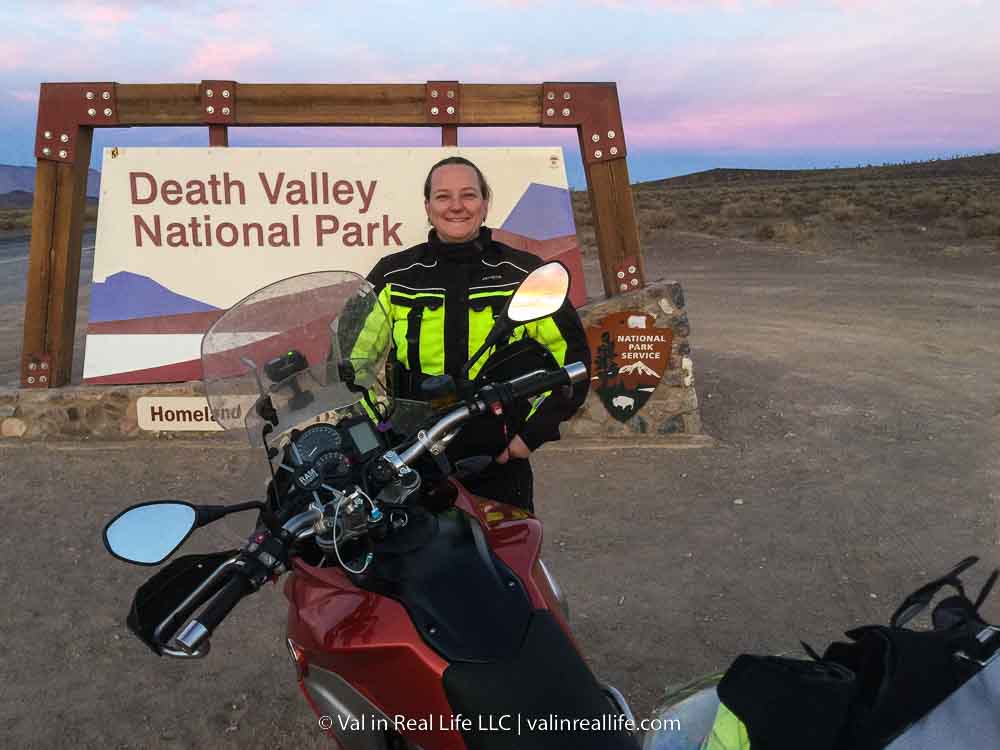
As part of weaving the tapestry I want, today I woke up in Death Valley. This place has grown more and more important to me in the last few years, on par with the Great Smoky Mountains and Great Sand Dunes. I’m eating the cupcake. And savoring it.
The Birthday Series
Fifty-four: Using My Powers For GoodFifty-three: Wake Up CallFifty-two: Full CirclesFifty-one: The Messy MiddleFifty: Leaning Into LifeForty-Nine: Keep Moving ForwardForty-Eight: Be Where Your Feet AreForty-Seven: The Most Important QuestionForty-Six: GratitudeForty-Five: Celebrating with AdventureForty-Four: Eat the CupcakeForty-Three: The Depth of LifeForty-Two: Another Year of PerspectiveForty-One: Another Notch on the Birthday BeltForty: Getting Real