Dive in to my adventures and travels of all kinds here. From outdoors to urban and via foor, auto, motorcycle, or as a full-time RVer, I’ve embraced adventures of all kinds.
Joe Hedrick wasn’t kidding. Camel racing isn’t for wussies.
That’s what he told us in our introduction at Virginia City’s 57th International Camel and Ostrich Races. Along with my fellow media-types, I listened intently to Joe’s warnings and admonitions to recuse ourselves at any second until the gate opened if we had any doubts.
We laughed nervously at the possibilities for death and dismemberment that Joe assured us were rare but very real. He made certain we were absolutely clear about what we were getting ourselves into before we signed lengthy liability waivers.
This is rodeo level hurt.
Joe Hedrick
No, camel racing is clearly not for wussies.
Camel selfies are more challenging than you’d think! Buddy the camel was not ready for his close up.
What Joe didn’t tell us
Joe then sent us off to ride camels at a walking pace to help us begin to understand what were getting. When my camel handler asked if I was nervous I answered with a confident “No.” Then after a couple of seconds, “Well, not yet.”
Even at a walk, the camel’s lumbering gait throws you forward and backward as well as side to side all at the same time. It’s not at all like the rhythm of a horse’s gait. I’m familiar with that from earlier experiences in English riding and show jumping. No, a camel is a different beast entirely.
Joe told us balance is the key to successful camel riding. So perhaps my motorcycling and yoga would be more useful than my long-past equestrian experience. We were advised to keep both hands on the “saddle” (I use the term loosely) and simply hold on. The other task was to keep our legs forward so we weren’t thrown onto the camel’s hump and left to teeter off the side.
The starting gate looms large. Until you’re six feet up on a camel’s back and you realize part of the starting gate is below your head. Then it feels quite small.
Beyond that, it was a matter of letting the camels do their thing. They know the drill; there’s not much for the rider to do but stay on. The caveat is that the animals sometimes decide to explore the far reaches of the track rather than cross the finish line.
I was scheduled to ride in the last heat of the first day of the races. All day I watched other riders struggle, or fall off, or back out. By the start of my race I was simply hoping to stay on. Winning just wasn’t a priority as I wobbled up into the starting gate in the blazing afternoon sun.
When a former bull rider in an earlier heat commented on the difficulty of staying on the camel, I thought, “Wow, I’m up a creek.” Doubts about my injured leg’s ability began to surface. I’ve come a long way since last year’s life-threatening injury but my leg isn’t what it used to be at all.
At one point I began to think my media pass would instead be a pass to my demise.Buddy the camel sizing me up. I think he was skeptical.In the starting gate.
My heat
Before setting us off on our racing adventure Joe introduced the riders in the center of the arena to the crowd. The three of us gave Joe the nutshell version of how we ended up there that day and set off towards the starting gate.
I was the last to mount up so I had the least time to get mentally prepared. For all the instruction we had on how to ride the camels, how to get on them wasn’t explained much other than “Be on or be off, don’t be in between.” Um… ok.
And we’re off… or we hoped we wouldn’t be.
Focused mainly on the actual racing of the camels, I didn’t realize that to get on them, we had to climb up the thin, wobbly starting gate walls with only one foothold along the way. Then balance on the one-inch wide metal wall, swaying in the wind until you attempt to launch yourself onto the camel’s back.
Once I was on my camel—named Georgia, coincidentally—Monty the camel handler put the lead in my hand and told me to duck so I didn’t whack my head on the starting gate. Then he asked me if I was ready. After my less-than-confident “yes” the gates burst open.
The camels jolted through the gates with a burst of energy. After 20 yards or so, all of the camels decided they were more in the mood for a jog or stroll than an all-out race. The rider to my right disappeared from my view as his camel decided to take the scenic route around the track. The rider to my left somehow ended up stalled in front of me at the turn. That’s when I decided to be more than just a passenger. I pulled Georgia’s lead to the left so she wouldn’t take the long way around my stalled competitor. She complied and picked up her pace a little as well.
I was in the lead with winning on my mind.
I couldn’t see the other riders to know if they were on my tail or wandering in the far reaches of the arena. As we approached the finish line at a semi-trot, Georgia began drifting off to the side of the track. I gave her a little verbal encouragement and pulled her lead back to the left to straighten her out. She complied yet again and we triumphantly crossed the finish line.
A camel-hump view of crossing the finish line!Not only did I stay on, I actually won my heat. I call that a successful day.
I was exhilarated. Until I discovered another unknown detail about camel racing. To dismount I was supposed to just jump off. There was no platform or even a flimsy gate to work with. And it’s a long way down from a camel’s back.
My heart sank. I looked at the ground far below and thought of Frankenleg. “Shit, what do I do?” I thought.
With no other options, I took a deep breath and plummeted off of Georgia’s back, intent on having my good leg take the full force of the jump. It was my Keri Strug moment as I landed with a thud in the soft, thick dirt and stuck the landing on my good leg.
And, just like that, all of the drama and exhilaration of my camel racing experience was over. In less than two minutes.
Joining the International Order of Camel Jockeys seemed as good as anything to add to my growing collection of oddball accomplishments, right?
“Shit!… are you kidding me?!? I don’t know about this. Shit-shit-shit-shit-shit!” (Or possibly stronger oaths.)
Those are the words I gasped in my headset to my dear man as the pavement suddenly deteriorated to something formerly known as asphalt. The sand and gravel covering it didn’t help matters. The unexpectedly unruly terrain had my bike dancing over its surface like a slapstick comedian trying to walk on ball bearings and banana peels.
This was my introduction to the Coos Bay Wagon Road in Oregon that he had joyfully selected as part of our route earlier that morning.
“Do you want to turn back?” he asked.
“I don’t know,” I said as my motorcycle wriggled like a restless toddler underneath me.
I took a few deep breaths and got rational. No. Backtracking was counter-productive. Suck it up. Ride. In spite of my confidence issues since last year’s crash, this isn’t that big of a deal. I reminded myself that I know how to do this. The situation is simply a surprise. How far could it be on this old logging road anyway, right?
The ball-bearings on glass scenario shifted to dirt and gravel. But with tight twisties. And then I found myself staring wide-eyed at a massive logging truck barreling at me around a blind corner on the narrow road.
More epithets ensued, of course, as I quickly corrected for the situation.
Those were only to myself this time. To my dear man, it was a calm “There’s a logging truck coming. Watch out.” That was the mom instinct kicking in. Finally. Project calm while internally freaking out. And not letting on how dicey the situation was for me.
It was then that I realized I was outriding him. He was not in my mirrors. I slowed to close the gap but he was way back, something that’s never happened before given his level of riding skills compared to mine. But on a new bike not equipped for this riding; a low sport-touring beast with no skid plate and a wide rear tire that might as well be a bouncy-ball on this terrain. My BMW F700GS was the better bike for the job, in spite of my lesser skills.
But that was more than mid-way through a 1,300-mile trip that started 4 days earlier.
The challenges of the Coos Bay Wagon Road forced retreat and rerouting — and a pause to check the integrity of our steeds after the effort.
A change of plans
So what do you do when your original plan for a motorcycle trip is waylaid by extreme temperatures and wildfires? You reroute, of course. That’s how I found myself wandering through northern California and Oregon instead of moseying my way south through the eastern Sierra.
The Independence Day holiday was approaching and we anticipated increasing traffic as the weekend approached. Our goal was to escape the brutal desert heat but avoid the building holiday traffic.
Not having ridden much in the west, this is all very new and challenging for me. I’ve been working on my skills on day trips in the eastern Sierra but the intensity of a seven-day trip of twisties and grades far more intense than in the east forced me to up my game considerably.
The riding in Lassen is nothing short of astounding. Several months later, my breath still catches thinking of the drama and beauty.
The route
My lackadaisical trip (yes, only 1,300 miles in seven days) wound from Carson City, Nevada to Eureka, California up to Coos Bay, Oregon, then back east around Crater Lake before returning to northern Nevada.
All in all, an excellent riding route. The Coos Bay Wagon Road was initially daunting but I eventually found my groove and ended up enjoying the ride. My dear man was having less of a good time. When we reached pavement again we felt triumphant. Then the road reverted to living up to its name, and we had to make a decision.
After chatting with a local and finding out we were looking at 20 more miles of slow-going, messy terrain, my partner gave that route a big thumbs down. By then, my tune had changed and I was kind of digging the idea of some more dirt. But it wasn’t worth risking damage to his bike, which isn’t designed for this kind of riding. Its low clearance on a rough road made the likelihood of busting his oil pan very high. And that would put an end to the trip. So we ended up backtracking to stay on more established throughways.
Keep in mind, this is the guy who looked at his 10-year-old map and said, “Hey, let’s try the wagon road. It’s probably paved by now.” We did consult Google Earth and saw plenty of blacktop. But we didn’t check the entire length of the road. Adventure travel. 🙂
Riding up the Oregon coast on Hwy 101 proved to be extremely challenging with erratic, strong winds. But this is still a spectacular ride.
Taking in the view of Crater Lake for the first time with my dear man.
The challenges
You know I’ve got some serious road-trip cred in my trusty Subaru Forester and while there are some overlapping challenges, motorcycle trips require an extra level of badassery. Contending with exposure and vulnerability make a two-wheel adventure a very different beast from a car journey. The truth is it doesn’t matter what kind of trip you’re on, there are always challenges. This is life, yes?
For this particular excursion, beyond still getting familiar with western riding, here are some of the more “memorable” challenges:
The heat in the valleys in the first two days made every mile feel like three or four. We fought to stay hydrated and keep our minds sharp in the numbing heat. It was soul-sucking.
We hit a number (ok, a lot…) of construction zones. The kind where you can wait up to 30 minutes for a pilot car. On scorching black asphalt in full gear, you can imagine the discomfort. At one point we had to park our bikes on the shoulder and scramble to the paltry shade of the only pathetic, scrawny tree in sight for a scrap of shade so that we didn’t roast.
Oh, Oregon, you do know how to blow a motorcycle around. I’m no stranger to intense weather and wind on the bike but the Oregon coast takes the cake on unpredictable, erratic winds. Gusts shifting around you constantly means you don’t know which direction the next blast is coming from. That kind of riding takes its toll. By the time you’re off the bike for the day, you feel like you’ve been in a boxing ring getting pummeled for hours on end.
My western bike, a gorgeous BMW F700GS, isn’t quite yet dialed in on ergonomics like my darling Moto Guzzi (“Nina”) in Georgia. That means fatigue from poor positioning; mainly throttle hand cramping and numbness. That will tire you out quickly. Hence the only 1,300 miles in seven days.
The heat and fatigue contributed to exhaustion that kept me from being productive at night. I know that’s not an issue for most folks out for a jolly trip, but it’s a reality of my blogger life and it became a point of frustration.
Imagine my ironic laughter hitting yet another construction zone… on a remote logging road in rural Oregon. I can’t help but think the construction gods were unhappy with us.
Even in a Crater Lake National Park we hit challenging road construction.
The rewards
Of course the reasons we adventurer-types do this is for the rewards; the groovy discoveries along the way.
It was my first visit to Lassen Volcanic National Park. This not-well-known park is breathtaking and includes some seriously fun riding. I’m bookmarking it for much more exploration in the future.
This trip also took me to Crater Lake National Park for the first time. By the time we arrived, the holiday crowds had already descended on the park. It was a madhouse. Another bookmark set for better timing.
We found several charming mom-and-pop motels. Complete with actual, honest-to-goodness keys to the rooms and owners running the front desk. And a retro mountain resort where time appears to have stopped in the 1970s. Very old school but fun.
We found unique, yummy places to eat. Local breweries, hamburger joints, cafes — they were ripe for the picking. I will admit to putting on a few pounds on this trip. Totally worth it.
All along the way, we met great people. Being on motorcycles just seems to make you more accessible and both riders and non-riders always love to chat about where you’re going.
The riding was phenomenal. I love my mellow, southern roads but the exhilaration that comes with the terrain here makes the heart pitter-pat.
I don’t know that I’ll ever stop gushing about riding in Lassen Volcanic National Park.
Would I do it again?
Yep. Absolutely. Great roads. Great riding. On a second go, I would either compress this trip down to five days or add on some miles to make it a fuller seven days. And just know what I’m getting into on the Coos Bay Wagon Road in advance. Then attack it with gusto!
My first view of the iconic Crater Lake in Oregon. Despite the bustling holiday crowds , there was no resisting wrestling the infrared camera from my panniers to grab a quick shot.
Some more random images from a crazy motorcycle adventure!
When I first visited Virginia City, Nevada two years ago, I arrived just after the conclusion of the annual Virginia City International Camel and Ostrich Races. I enjoyed exploring Virginia City as the town seemed to be taking a huge, post-event collective breath.
But let’s face it — Camel and Ostrich Races! That’s something I knew I had to see. And now I get to. Next week I head back to Virginia City for what should prove to be a singularly entertaining life experience.
When I arrived in Virginia City in 2014, the races had just concluded. The races happen every September after Labor Day.
First, a little background
All of this camel hilarity started, not surprisingly, as a practical joke. The credit goes to Nevada’s first newspaper, the Territorial Enterprise. It has a unique and colorful history dating back to its start in 1858. To give you an idea of the publication’s tone, it was during his stint working for the Territorial Enterprise that Sam Clemens became Mark Twain. The camel races didn’t start until long after Twain’s time, but he was not the only sharp-witted jokester in the paper’s history by a long shot.
The story of the race’s beginnings certainly fits with the legendary city and newspaper’s long wild-west history. Of course, legends are not bound by the facts of history so the details tend to vary a bit depending upon which source you consult.
The condensed story as I’ve gathered is that in 1959, then-editor Bob Richards ran a fictitious news story about camel races as a practical joke. Tall tales and made-up stories were a common occurrence at the Territorial Enterprise so many knew not to take the story seriously. The San Francisco Chronicle picked up the story and, either having fallen for the hoax or to expose it, showed up with a team of camels to race. Not to lose face, Richards made the race happen, a tradition was born, and we now get to reap the benefits.
The shiny new arena for the ever-popular International Camel and Ostrich Races. (Photo courtesy of Virginia City Tourism Commission)
Fifty-Seven years later
The event’s history may be the stuff of legend but even today the races are generating new stories for a modern age. As part of this adventure, I’ll have to opportunity to ride one of these beasts. That will be quite a sight, I’m sure. I’m also really looking forward to watching the professional camel and ostrich racers work their magic.
The event continues to increase in popularity as you can imagine. So in 2015, Virginia City unveiled its new arena to accommodate the ever-growing crowds that throng to see camels, ostriches, and zebras race. Yes, zebras. Just when you think this couldn’t be any more over-the-top!
The races seem to be universally appealing. Everyone I talk to about them asks me countless questions, the last ones usually being “When is it?” and “How do I get tickets?” When I told 13-year-old George what I’d be doing, he said “Ostrich races might be the best thing ever!”
I hope you’ll stay tuned as I bring you all of the excitement, including Val on a camel. I’ve ridden a lot of things in my life but never a camel. I really see no way for this to go except pure comedy. Promise you’ll laugh with me, not at me, ok?
Back in April, I ventured out for my second time at the Horizons Unlimited Traveller’s meeting in Appomattox,Virginia. Before I left, I extolled the virtues of extended travel and how it gives a traveler the ability to have a richer experience. Because of changing how I approached this trips by combining with my annual spring photography workshop in the Smokies, I succeeded in my goal of being able to enjoy seeing more along the way.
The day of my visit, I rode in from Lynchburg through fog and occasional spits of rain. The weather added quite a somber note to a place steeped in legend and turmoil. It’s easy to overlook this was a town like any other. Life happened here. And then the climax of our civil war cemented it’s place in U.S. history on April 9, 1865.
A bonus of a premier historic site like Appomattox is the presence of living history enactments.
The entire town was the Appomattox Court House not just one building. In fact, there were many more buildings than are still standing today. As a modern-day visitor, it takes imagination to mentally replace those buildings, the people, and the lives that were lived here to create a picture of what used to be.
Fortunately, as with many of our impressive national parks, Appomattox is equipped with knowledgable rangers, exhibits, and videos that help us piece together what it used to look like, why this place is worth preserving. One of the elements to historic sites that brings the story to life for me are actual relics of the time. Appomattox has some artifacts that give visitor’s pause as well as insight into a time much different than ours such as photographs, parole tickets, swords, uniforms, letters, and even bits of flags flown there.
In addition to artifacts and photographs, the park staff has painstakingly recreated what the interiors of the buildings may have looked like. No one swooped in to preserve this place in the aftermath of Lee’s surrender. So much of the original furnishings and contents were moved or lost.
The Mclean’s themselves, the owners of the house in which Lee surrendered, succumbed to debt and moved on. At one point the McLean House was dismantled to relocate it to Washington D.C. but the materials were never moved and they slowly decayed. Hindsight to us might scream for everything to be perfectly preserved but life simply went on in the wake of the end of the war and the town fell into hard times. It wasn’t until the mid-1930s that the National Park Service sought to restore the town and reconstruction of the McLean house didn’t take place until 1948-1950.
And that’s just one small part of the story that’s preserved at Appomattox Court House National Historic site. There’s much more than the town center itself to be experienced. It’s a premier unit of our national park system and well worth a visit. For a better look at my time there, here’s a slideshow from my visit:
For some, extended travel seems wearisome. Spending weeks (or months, or years) on the road, not seeing your home, managing your life from a distance, finding laundromats, having to find a new place to sleep or set up camp every few days, all of the uncertainties—there are definitely some challenges.
Fred and George getting blown away at Craters of the Moon on one of our mondo road trips.
For me though, short-term yo-yo travel is harder: trying to pinwheel out from my home base to attend events and explore, packing and unpacking frenetically, losing time going back-and-forth. It’s a perverse commute. Sometimes I don’t know if I’m coming or going.
Last fall I had five separate trips in six weeks. It was exhausting. I would have saved myself a lot of time and energy if I’d combined some of them by not trying to come back to my HQ for only a day or two before leaving again. I also would have more content to share with you if I had slowed down and shared the journey instead of racing between places because my timeline was so tight. And it forced me to press through hard weather when giving myself more room to avoid energy-draining conditions would have been safer for me.
Thinking back to that batch of trips got me musing about the difference between the weeks-long expeditions I’ve done in the past and short weekends away. There are people who love to jet off for weekends frequently. It refreshes them from their daily routine, which may be difficult to leave for longer stretches. I admire that they’ve found a way to manage travel with limited time available.
And I’ve realized that I don’t enjoy frequent micro-adventures. It feels like a lot of energy for not enough return. I love the rhythm of longer trips.
Giving myself more travel flexibility means I can avoid situation like this when I spent hours warming up and waiting out a storm at a Waffle House.
It helps me avoid feeling like my adventure is over when it’s just getting started.
There’s less pressure to do everything. I accept that I’ll need laundry days and time to catch up on personal items, work, etc. Just like at home. And that a do-everything pace isn’t necessary or even sustainable for longer trips.
There’s a much greater element of self-reliance to longer journeys. There’s less “I’ll fix it when I get home.” I have to address issues in the moment, with my own wits. It’s empowering.
It requires more resilience and flexibility. And returns more immersion and connection with places and people.
It changes my mindset about vulnerability. One, by embracing help from strangers. Two, by recognizing I am no more or less safe as I travel than I am at home. For many people, distance from home creates anxiety. Realizing you can handle situations while traveling almost as easily as you can at home is often a revelation.
The wonderful thing about taking on anything new in our lives is the sense of release and freedom when you realize your comfort zone has been suffocating you. Extended travel is one of those wonderful things that will make you question what you were so frightened about. And there’s no putting yourself back into the box once you’ve busted out of it. Life becomes bigger. Possibilities emerge that you never dreamed of.
What do you think? Do you prefer extended travel? If you’ve never tried it, would you if you were able?
Cheers, friends. Adventure on!
Longer travel allows me to stop and smell the flowers. 🙂
When I attended my first Horizons Unlimited Travellers meeting in April of last year, I didn’t know what to expect. It ended up being a delightful feast of adventurous souls, practical knowledge, and the beginning of beautiful friendships.
It was a no-brainer then, to dart off to to the Horizons Unlimited North Carolina event last October. Held at the Iron Horse Motorcycle Lodge near Stecoah, I set out with the promise of connecting with many more experienced adventure travelers and seeing what I could learn.
The cozy grounds of the Iron Horse Motorcycle Lodge lend themselves to relaxing.
The North Carolina travellers meeting proved to be surprisingly different from my first experience in Virginia and equally delightful. The venue is smaller so there aren’t as many presentations or attendees but connecting with other travelers is more intimate.
As I grasped how varied these get togethers could be, I realized that’s the joy of them. They’re held all over the world and each one has its own flavor. Reports from friends who’ve attended other travellers meetings confirm that it’s never the same experience twice. Different places, different attendees, different presenters, and different organizers make each one unique but still under the umbrella of the larger motorcycling community.
Camping at the Iron Horse Motorcycle Lodge.
In the end, that’s what this is about — community centered on a common passion. This is where we can share our triumphs and challenges with people who understand. It’s where we can talk shop with people who care about motorcycle travel as much as we do ourselves. It’s about focused time with your tribe.
And that’s why I’m heading back to the Virginia meeting this month. Since I’ve attended at that location before, I know there will be the comfort of familiar friends but also the intrigue of the new and unexpected. And I actually get to ride this time! Which is awesome. 🙂
Sam Manicom had us enthralled with his tales of travel in Africa.
Shared tales of travelers are part of the connection at Horizons Unlimited.
I’m often told I am and it makes me laugh. I think “Are you kidding me?!?” Of course I have fear. Lots of it.
The well-meaning commenters see it as a compliment to tell me I am fearless. I understand the intent. Especially the extra layer of concern that is draped over the compliment for a woman who travels solo as I do, quite a bit.
To the recipient of the compliment, though, it’s dismissive. It’s a disservice to how hard I work for triumph over fear and uncertainty. Because I’m successful, sometimes, doesn’t mean it comes easily.
The bottom line is that everyone has fear. Well, maybe some people don’t but that’s a special case. As Lt. Worf says on Star Trek: The Next Generation…
Only fools have no fear.
And certainly being fearless is quite foolish. It leads to bad decisions. Having some fear simply means I’m thinking in terms of risk management rather than racing thoughtlessly into adventures.
Fear is an oft-discussed topic amongst adventure travelers. To outsiders, our lifestyles seem to be anything from irresponsible to reckless, but that’s simply their own fear talking. And a lack of understanding about what we do. For us, this lifestyle is important enough that we’re willing to work through fear. The other part of the equation is that what we do isn’t as dangerous as it seems to those inexperienced in adventure travel.
You give up a lot when you venture into an environment that you can’t control and where your senses don’t serve you in dependable ways.
She wasn’t talking about adventure travel but it resonated with me in that sense, nonetheless. Whatever leaps we take in life, the uncertainty often strips us bare before we reap the beautiful and exhilarating rewards of challenging and overcoming fear.
I had a lovely, long chat with Ted Simon at Overland Expo East last October. He’d been musing on a quote from one of his books…
There is a way to convert fear into positive energy. When I had discovered it along the way, I used it quite deliberately to project confidence and sympathy. It had never failed me, and it gave me an unusual and exhilarating sense of power over circumstance. But it seemed to function only when I was alone.
The quote struck a chord with me. Because traveling solo is a very different experience in fear than traveling with companions. The resulting empowerment of handling anything and everything on your own is extraordinary.
I am not fearless. But I am brave. Especially when it comes to building the life I want on my terms, embracing fear and overpowering it.
Adventure on, friends.
Ted was kind enough to let me keep his note with the quote on it. And I hope he feels the coffee I spilled on it adds character. 😉
A while back I talked about some of my strategies for personal safety on the trail. One of the pieces of that strategy is a GPS tracking device. Whether I’m traveling by car, motorcycle, or foot, this technology is something I greatly appreciate. Especially when I’m solo.
Why carry one?
There are various mindsets about carrying a GPS tracker. Some folks feel it plays into paranoia, fear, and an unreasonable need to stay connected. However, most people I talk to like having access to help in unexpected situations. When I’m out of cell phone range on an adventure, being able to do the equivalent of dialing 911 doesn’t seem over-the-top to me.
Is it necessary? Of course not. But given how accessible the technology is, I prefer having a means to communicate in an emergency. It’s a small, easy precaution that has big benefits when the shit hits the fan.
Why DeLorme inReach?
Up until now I’ve been using a SPOT Connect. It’s served me relatively well for most of the time I’ve had it. Then it failed me entirely at the beginning of a 1,500-mile solo motorcycle trip last September. Not cool.
After a lengthy discussion with Delorme reps at Overland Expo East, it became clear it was time to retire my old soldier and think bigger. Delorme has upped their game considerably in the time since I originally compared SPOT and inReach many years ago.
The DeLorme inReach Explorer in the field.
Apples and oranges…
Here’s the deal: the various SPOT trackers and Delorme inReach devices are not the same beasts at all even though on the surface they perform the same basic function. Yes, they are both GPS trackers. And that’s where the devices part ways in terms of functionality.
Here’s a breakdown of what I like about the inReach:
inReach allows for two-way communication, SPOT tracking devices do not. Is that a big deal? That’s up to you. Here are a couple of things to think about if you are uncertain. First, if you need help, with SPOT you don’t know if or when the message was received and when you might expect help. That will impact your decisions about how to help yourself in the meantime. Second, you may be having a fine adventure but something has gone wrong at home and they can’t let you know. I think it’s probably clear where I stand on that… I prefer the richer communication.
Delorme’s inReach uses the Iridium network of satellites whereas SPOT uses Globalstar. That means the inReach has much better coverage worldwide. My experience with SPOT’s coverage was often very sketchy. So far the inReach coverage has vastly outperformed SPOT.
The inReach has some useful features like an altimeter, compass, waypoint setting, social media interfaces, and trip stats to go along with the main feature of tracking your position and hailing for help.
The cell phone app is a nice interface but the device still works without the interface. My SPOT connect needed that connection in order to use anything more than the SOS feature and for people to track me online.
Both companies offer online mapping for your friends and family to track your progress but again, DeLorme outperforms SPOT in that function. The interface simply has more features and better usability. Different subscription levels offer more precision on location detail.
Overall, the DeLorme inReach will cost you more on initial device purchase as well as the recurring subscription. However, put in context, you’re getting much more value for the investment. And DeLorme offers various levels of subscription service as well as the ability to switch between them on a monthly basis or even temporarily suspend your subscription.
The SOS feature on the inReach is far more sophisticated than SPOT. You can detail the situation you need help with and you can cancel it if you’ve mistakenly triggered it.
The inReach Explorer offers trip stats as one of its many features.
Glitches…
While the inReach far-and-away provides more functionality overall, programming and entering info from the device itself is cumbersome. The good news is that it’s easy enough to set up online and bypass having to inch your way through menus and entering data on the device itself.
The inReach doesn’t import .gpx files for geocaching. That realization elicited quite a poetic string of profanity from me because I really, really want a geocaching device that works out of cell signal but I don’t want to carry yet another device. So “Dear DeLorme, please make this happen. I will be your biggest fangirl. You owe me for the atrocity that is the PN-40…” (see below) (UPDATE 3/21/16: My initial information was that the device didn’t support .gpx files… BUT it turns out the Explorer does and I know have geocaches loaded on my device. So I guess I’m officially DeLorme’s biggest fangirl. 🙂 ]
DeLorme’s online map interface allows you to share your trip with friends.
Why did I wait so long?
My initial entry into the GPS tracker arena was colored by a few factors. My first look at both DeLorme and SPOT options left me underwhelmed so I didn’t get one at all. After a while, I figured something was better than nothing so I had to make a choice. Both companies got less-than-favorable customer service reviews at the time so it came down to cost and experience. The SPOT Connect I chose was a little less expensive in initial device cost as well as average subscription cost.
One other nebulous factor was feeling like the increased functionality of the DeLorme inReach was simply feature creep in my life that I didn’t really need.
The real tipping factor was my utter detest of the DeLorme PN-40 which I’d been using for geocaching. It had been nothing but a frustration of technical difficulties and I can honestly say I’ve never hated a piece of gear so much in my life. As you can imagine, I had a very unfavorable opinion of DeLorme overall as a result of my experience with the PN-40. So note to companies… a bad experience stays with your customers a very, very long time.
The big picture…
If you’re in the market for a tracker, I hope this information helps. I think it’s quite clear I’m sold on DeLorme’s inReach Explorer and now count it as one of my essential pieces of gear.
Disclaimer: Delorme gave me a professional discount on my purchase of the inReach Explorer to test and review the product here on Val in Real Life. My opinions are my own. Your experience and results may vary.
[Update: DeLorme was purchased by Garmin as of April 2016 and now offers several versions of this product.]
And now for your moment of green…
When out exploring the expanses of the world, my DeLorme inReach Explorer is one of my most important pieces of gear.
The new visitor center at Pahranagat National Wildlife Refuge.
Tucked off of the very busy Highway 93, 80 miles north of Las Vegas, you’ll find Pahranagat National Wildlife Refuge. This Nevada oasis seems horribly overlooked by the cars and trucks hurtling by.
I’m sure they see it. There’s really no way to miss it. The lush landscape is a startling contrast to the Nevada desert surrounding it.
I myself have passed it by in my rush to be elsewhere. But slide off onto the access road to Upper Pahranagat Lake and the frenetic pace of the highway becomes only a distant rumble. This avian haven becomes your haven as well.
Getting started at Pahranagat…
I always recommend a stop at the visitor center in order to best acquaint yourself with the offerings. Unfortunately for me, I arrived on a Tuesday when the center was closed and would not open again until Friday when I was departing. Great timing, eh?
What I discovered when I popped in on Friday though, was a brand-new facility ready to invite visitors to discover the wonders of Pahranagat. The exhibit includes many interactive features that appeal to kids and adults alike. Much of the focus is on wildlife but the it also includes a look at human history in the area.
Like many of our public lands visitor centers, Pahranagat offers a short film you can watch to better understand the refuge before setting out to explore it. I highly recommend taking the time to watch. This is also where you can pick up brochures and guides, as well as an extensive bird list for the refuge.
The exhibit in the visitor center will give you a sense of what Pahranagat has to offer curious visitors.
Sit a spell and enjoy the film introduction to Pahranagat… while the little ones are happily coloring.
History and importance…
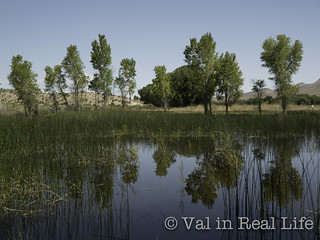
The desert along Highway 93 suddenly turns to a lush oasis .
Pahranagat National Wildlife Refuge was designated in 1963 and straddles the boundary of the Mojave and Great Basin deserts. At over 5,000 acres, this “Valley of Shining Water” is fed by thermal springs. It is truly an oasis that is a critical stopover for migrating birds. All told, this refuge plays host to over 200 species in varying frequencies.
This diverse environment is not just for the birds, though. Because Pahranagat includes lakes, wetlands, riparian habitat, meadows, and desert uplands, you can find a variety of wildlife and plants here year-round. Everything from desert tortoises and mule deer to willows and wildflowers. Obviously Pahranagat is a popular destination for birds and its stewards manage water levels to maximize habitat for various species throughout the year.
Your explorations aren’t limited to flora and fauna. Pahranagat is also home to human history. It has been used by natives for thousands of years. Pictographs and petroglyphs can be found here as well as the Walden House, a relic of pioneer times.
Wetlands in the midst of a desert provide a vital stopover for migratory birds.
Things to do…
A walk around Upper Pahranagat lake will only take an hour or so and the terrain is not challenging.
With the natural and cultural resources Pahranagat offers, you have a lot of choices how to spend your time. While most of the action is at Upper Pahranagat Lake, don’t overlook other areas for opportunities to explore.
Because of the importance and diversity of this refuge, you’ll find something to do and see year-round.
Pahranagat’s 5,000+ acres of lakes, wetlands, and desert will give you plenty of options to explore.
A spot to rest on the west side of Upper Paharanagat Lake.
Camping…
Camping at Pahranagat. There are free back in, pull-through, and buddy sites available first-come, first-served.
There are 14 campsites nestled on the eastern banks of Upper Pahranagat Lake. They are free and first-come, first-served. They span the length of the lake, giving ample space between sites. The various sites accommodate back-ins and pull-throughs. A few are “buddy” sites that allow a larger group of visitors.
I thoroughly enjoyed my stay at Pahranagat. It’s now one of my favorite camping spots. There are a few things to keep in mind if you’re considering a visit:
There is no potable water and no electric connections.
Vault toilets are scattered along the campground but I often found them without paper since I was visiting during off-days. Fortunately I’m a seasoned camper… I always bring my own.
There are no fire pits and ground fires are not allowed.
Sites are equipped with picnic tables and hibachi grills.
This is a wetland. There are mosquitoes. Plan accordingly, especially in the dawn and dusk hours.
You will experience some road noise from Highway 93 which runs along the refuge border, above the campsites. I didn’t find it to be too obtrusive to keep me from enjoying my stay.
My view from campsite number 5. Amazing, no?
Tips and tidbits…
Gnarly old trees come to life in the fading light at Pahrangat National Wildlife Refuge.
Some other things to keep in mind for your visit:
There is a covered pavillion at the entrance.
Again, there is no potable water. Remember to bring an adequate supply, even for a day trip.
Always educate yourself on park rules. In the case of Pahranagat, it’s important to note there is no swimming allowed and no motorized boats or off-road vehicles are permitted. Refer to the Pahranagat National Wildlife Refuge website for current and complete information.
If you’d like to visit but don’t want to camp, you’ll need to head north a few miles to Alamo, Nevada. That’s where you can secure fuel and basic supplies. This is a fairly remote area but there are a few lodging and restaurant options in Alamo.
The most popular spot for lodging and dining in my experience is Windmill Ridge, another five-ish miles north of Alamo on Highway 93. Geocachers may recognize this as the premier spot to use as a base for tackling the lower section of the E.T. Highway power trail.
The stunning sunsets of Pahranagat hold personal importance to me. This place will always be a special spot.
Connecting…
I’ve seen a lot of wonderful places in my time traveling around North America and I have fond memories of them. Then there are places that have a deeper impact. Maybe it was the combination of place, timing, and my emotional needs that came together to cement Pahranagat National Wildlife Refuge as one of those special places.
I love our national park system, of course. But I always encourage people to explore the lesser-known public lands like Pahranagat or other refuges, national forests, and monuments. They’re just as fabulous and typically don’t have the crowds and chaos of the marquis parks. In these places, you get a better understanding of our public lands and a better chance to find peace.
Finally, here’s a YouTube video of my time at Pahranagat… several days of exploring and photography boiled down to two minutes. You can find more images in my Pahranagat album on Flickr. Enjoy!
Adventure on, friends.
And now for your moment of green…
Stop at Pahraganat to discover the unexpected side of Nevada.